Supply Chain Management Marketable Skills & SCM at Collin Details

Supply Chain Management (SCM) is one of the fastest-growing and most essential fields in today’s global economy. It connects every step of a product’s journey from sourcing raw materials to delivering finished goods to customers. Businesses rely heavily on efficient supply chains to remain competitive, reduce costs, and meet customer expectations.
Supply Chain Management (SCM) is one of the fastest-growing and most essential fields in today’s global economy. It connects every step of a product’s journey—from sourcing raw materials to delivering finished goods to customers. Businesses rely heavily on efficient supply chains to remain competitive, reduce costs, and meet customer expectations.
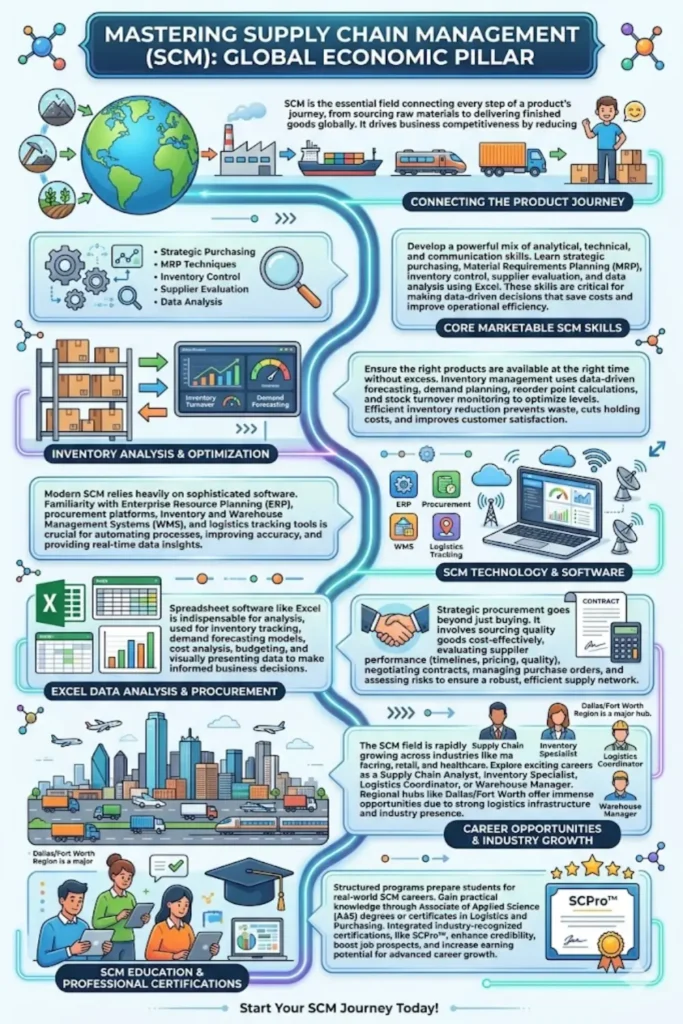
With increasing globalization and digital transformation, the demand for skilled professionals in logistics, procurement, and inventory management continues to rise. This makes SCM a highly practical and marketable career choice for students who want stable growth and diverse job opportunities across industries.
Core Marketable Skills in Supply Chain Management
To succeed in supply chain roles, professionals must develop a combination of analytical, technical, and communication skills. These skills are highly valued by employers and directly impact operational efficiency.
Key Skills You Will Learn
- Strategic and tactical purchasing management
- Material Requirements Planning (MRP) techniques
- Inventory control and optimization
- Warehouse and receiving operations
- Supplier evaluation and procurement analysis
- Data analysis using spreadsheet tools like Excel
- Communication through professional email platforms
These skills are not just theoretical; they are applied in real-world scenarios where decision-making directly affects cost savings and customer satisfaction.
Why These Skills Matter
Understanding how to manage inventory or analyze supplier performance helps organizations reduce waste and improve service delivery. For example, increasing inventory turnover ensures that products move faster, reducing storage costs and risk of obsolescence.
You can also read: R3 Million Primary Residence Exclusion
Inventory Analysis and Optimization Techniques
Inventory management is a critical function in SCM. It ensures that the right products are available at the right time without overstocking or understocking.
Professionals use data-driven approaches to analyze inventory patterns and identify inefficiencies. This includes evaluating demand trends, lead times, and stock levels.
Common Inventory Optimization Methods
- Forecasting demand using historical data
- Reducing excess stock to minimize holding costs
- Improving reorder point calculations
- Monitoring stock turnover ratios
- Identifying slow-moving or obsolete items
By applying these methods, businesses can enhance customer satisfaction while maintaining cost efficiency.
Technology and Software Knowledge in SCM
Modern supply chains rely heavily on advanced software systems to streamline operations and improve accuracy. Having basic awareness of these systems is a valuable asset.
Common Supply Chain Software Tools
- Enterprise Resource Planning (ERP) systems
- Procurement and supplier management platforms
- Inventory and warehouse management systems
- Logistics and transportation tracking tools
These tools help automate processes, reduce manual errors, and provide real-time insights into supply chain performance.
Role of Excel and Data Analysis in SCM
Spreadsheet software plays a crucial role in supply chain operations. Excel is widely used for data analysis, reporting, and decision-making.
Professionals use Excel to track inventory levels, analyze supplier performance, and create forecasts. It also helps in visualizing data through charts and dashboards.
Key Excel Applications in SCM
- Inventory tracking and reporting
- Demand forecasting models
- Cost analysis and budgeting
- Supplier performance evaluation
- Data visualization using charts
Strong Excel skills can significantly improve efficiency and accuracy in supply chain tasks.
You can also read: Eskom Graduate in Training Programme
Procurement Processes and Supplier Management
Procurement involves sourcing goods and services from suppliers while ensuring quality, cost-effectiveness, and timely delivery. It is a strategic function that directly impacts business performance.
Professionals evaluate supplier performance using data such as delivery timelines, product quality, and pricing consistency.
Key Procurement Activities
- Vendor selection and negotiation
- Purchase order management
- Contract evaluation
- Supplier performance analysis
- Risk assessment in sourcing
Effective procurement ensures that organizations maintain strong supplier relationships and minimize disruptions.
Communication Skills in Supply Chain Operations
Clear communication is essential in SCM, as it involves coordination between multiple departments and external partners.
Email platforms are commonly used for professional communication, including order confirmations, supplier negotiations, and internal updates.
Communication Best Practices
- Writing clear and concise emails
- Maintaining professional tone
- Documenting transactions and agreements
- Coordinating with cross-functional teams
- Responding promptly to queries
Strong communication skills help prevent misunderstandings and improve operational efficiency.
Supply Chain Management Program Overview at Collin
Collin’s Supply Chain Management program is designed to prepare students for real-world careers in logistics, purchasing, and inventory management. The program offers both degree and certificate options, making it flexible for different career goals.
Students gain practical knowledge and hands-on experience that align with industry requirements. The curriculum focuses on building both technical and analytical skills.
Program Offerings
- Associate of Applied Science (AAS) in Supply Chain Management
- Certificate in Logistics
- Certificate in Purchasing
This structured approach allows students to specialize in areas that match their career interests.
You can also read: SASSA E life Certification Portal
Career Opportunities in Supply Chain Management
The supply chain industry offers a wide range of career opportunities across sectors such as manufacturing, retail, healthcare, and transportation.
Popular Job Roles
- Supply Chain Analyst
- Inventory Control Specialist
- Logistics Coordinator
- Procurement Officer
- Warehouse Manager
The field currently employs millions of professionals and continues to grow rapidly, offering long-term career stability.
Regional Advantages and Industry Growth
The Dallas/Fort Worth region is a major hub for supply chain operations. It features extensive infrastructure, including transportation networks and logistics companies.
Key Regional Highlights
- Hundreds of motor carriers and logistics firms
- Multiple air cargo carriers
- Major rail lines and airports
- Strong presence of supply chain service providers
This environment provides students with excellent opportunities for internships and employment after completing their studies.
Professional Certifications and Industry Integration
The program is integrated with SCPro™, a recognized certification series in the supply chain industry. These certifications enhance a student’s credibility and career prospects.
Benefits of Professional Certification
- Industry-recognized credentials
- Improved job opportunities
- Higher earning potential
- Advanced knowledge and skills
- Professional growth and networking
Certifications demonstrate expertise and commitment to the field, making candidates more attractive to employers.
Summary of Skills and Learning Outcomes
| Skill Area | Key Competencies Gained | Career Impact |
|---|---|---|
| Inventory Management | Stock control, forecasting, optimization | Reduces costs and improves efficiency |
| Procurement | Supplier evaluation, purchasing strategies | Ensures quality and cost savings |
| Data Analysis | Excel modeling, reporting, forecasting | Supports informed decision-making |
| Logistics Operations | Transportation, warehousing, coordination | Enhances delivery performance |
| Communication | Professional emails, coordination skills | Improves teamwork and clarity |
Conclusion
Supply Chain Management is a dynamic and rewarding field that combines analytical thinking, technical expertise, and strategic planning. With the right education and skill set, individuals can build successful careers in various industries.
You can also read: South Africa Fuel Cut Extension Details
Programs like the one offered at Collin provide a strong foundation for entering this growing field. By focusing on practical skills, industry tools, and real-world applications, students are well-prepared to meet the demands of modern supply chains.
