NSFAS Applications 2027 Funding Planning Check Required Documents & Apply Through myNSFAS Portal

NSFAS (National Student Financial Aid Scheme) provides financial support to South African students who cannot afford higher education. The 2027 application cycle is expected to open in September 2026, giving students enough time to prepare their documents and plan their studies properly.
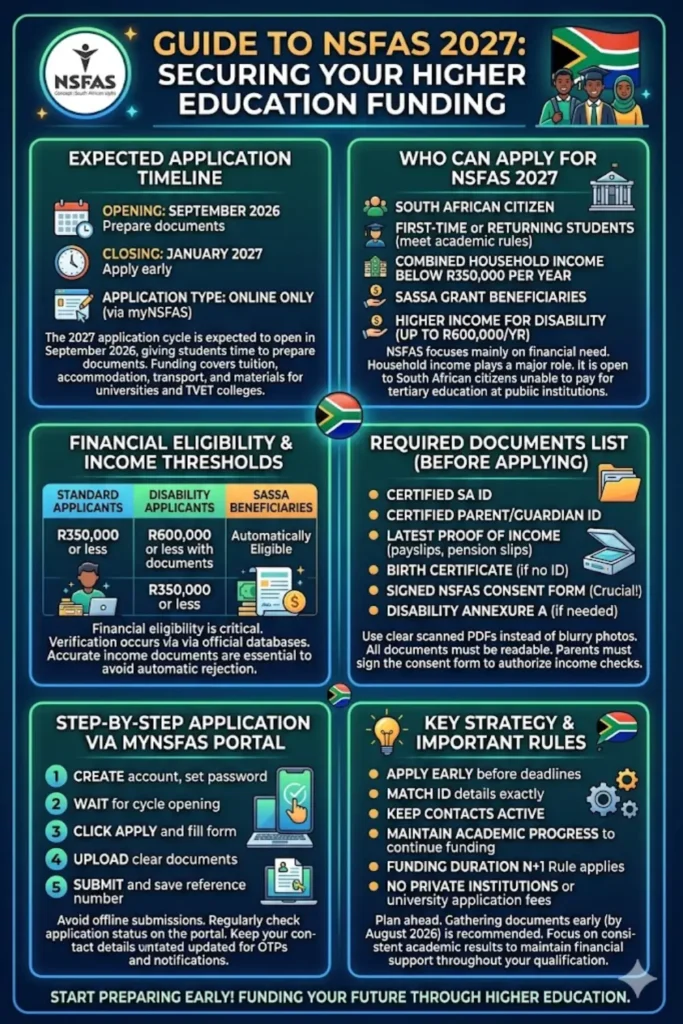
This funding is very important for Grade 12 learners and returning students because it helps cover tuition fees, accommodation, transport, and learning materials. However, success depends on submitting a complete and correct application through the myNSFAS portal.
Students must understand that NSFAS is not only about academic marks. It is mainly focused on financial need, meaning your household income plays a major role in approval.
Expected Application Timeline and Funding Overview
The NSFAS 2027 application process is expected to follow a similar schedule as previous years. Students should be ready early to avoid missing deadlines or facing last-minute errors.
The expected timeline is:
- Opening: September 2026
- Closing: January 2027
- Application Type: Online only via myNSFAS
Funding also depends on your institution type. TVET colleges and universities both qualify, but allowance structures may differ depending on accommodation or transport needs.
NSFAS is designed to support students throughout their qualification period, including an additional year under the N+1 rule. This means you must complete your studies within the allowed time frame.
You can also read:
Who Can Apply for NSFAS 2027
NSFAS is open to specific categories of students who meet academic and financial conditions. It mainly supports South African citizens who are unable to pay for tertiary education.
To qualify, you must meet the following criteria:
- South African citizenship
- First-time entering students or returning students meeting academic progress rules
- Combined household income below R350,000 per year
- SASSA grant beneficiaries (automatically eligible but must still apply)
Students with disabilities can qualify under a higher income threshold of up to R600,000 per year. Eligibility is not only about income but also about whether you are studying at a public university or TVET college. NSFAS does not fund private institutions.
You can also read: SASSA Grants Starts New R8,070 Income
Financial Eligibility Rules and Income Thresholds
Financial eligibility is the most important part of NSFAS approval. Even if you have good academic results, your application may be rejected if your income does not meet the requirements.
Income Limits Summary
| Category | Annual Household Income Limit | Notes |
|---|---|---|
| Standard Applicants | R350,000 or less | Most applicants fall here |
| Disability Applicants | R600,000 or less | Requires disability documentation |
| SASSA Beneficiaries | Automatically eligible | Must still complete application |
If your household income exceeds the limit, your application may be rejected automatically. NSFAS verifies income through SARS and supporting documents, so accuracy is very important. Applicants must ensure that all financial documents such as payslips, IRP5 forms, or pension slips are up to date and clearly readable.
Required Documents for NSFAS Application
Proper documentation is one of the most important steps in the NSFAS process. Missing or unclear documents are the main reason applications get delayed or marked as incomplete.
You must prepare your documents in digital format, preferably PDF, before applying.
Required Documents List
- Certified copy of your South African ID
- Certified IDs of parents or guardians
- Latest proof of income (payslips, employment letters, or pension slips)
- Birth certificate (if ID is not available)
- Signed NSFAS consent form
- Disability Annexure A (if applicable)
Make sure all documents are clear and not blurry. Scanned copies are always better than photos taken from a phone. It is also important that parents or guardians sign the consent form, as NSFAS uses this to verify income information directly from official databases.
Step-by-Step Application Process via myNSFAS Portal
The NSFAS application is fully online and must be completed through the official myNSFAS portal. Any offline submission is not accepted.
Application Steps
- Create a myNSFAS account using your ID number
- Set a secure password and verify your contact details
- Wait for the 2027 application cycle to open
- Click on “Apply” and complete the form
- Upload all required documents in correct format
- Submit the application and save your reference number
After submission, students should regularly check their application status. It may change from “Submitted” to “Under Review,” “Validation,” or “Provisionally Funded.” Keeping your phone number and email active is very important because NSFAS uses OTPs and notifications for updates.
Important Application Strategy for Approval Success
Many students lose funding opportunities due to avoidable mistakes. A strong application strategy improves your chances of approval.
Key Strategy Tips
- Use clear scanned documents instead of blurry photos
- Ensure all personal details match your ID exactly
- Submit application early before deadlines
- Keep your contact details active and updated
- Double-check all uploaded documents before final submission
One of the most important steps is ensuring the consent form is properly signed. Without it, NSFAS cannot verify your household income, which can delay your application. Students should also prepare documents early, ideally by August 2026, so there is no rush when applications open.
You can also read: SASSA Grant-in-Aid 2026 Who Qualifies
Key Rules and Funding Conditions
NSFAS funding comes with specific rules that students must follow to remain funded throughout their studies. Understanding these rules helps avoid losing financial support.
Important Conditions
- NSFAS covers the full duration of your qualification plus one extra year (N+1 rule)
- You must maintain academic progress to continue receiving funding
- NSFAS does not cover private colleges or institutions
- Application fees for universities are not included
Students who fail too many modules or change courses frequently may lose funding eligibility. Therefore, consistent academic performance is important.
NSFAS also provides allowances for accommodation, transport, and learning materials, but the amount depends on the institution and student needs.
Conclusion
NSFAS 2027 applications are an important opportunity for students who need financial support to pursue higher education. Early preparation, correct documentation, and careful attention to application details are key to success.
Students should focus on gathering all required documents, understanding eligibility rules, and applying through the official myNSFAS portal as soon as the system opens in September 2026.
You can also read: SASSA May 2026 Children Grants Increased
With proper planning and awareness of the funding rules, students can increase their chances of securing NSFAS support and successfully continuing their academic journey.
