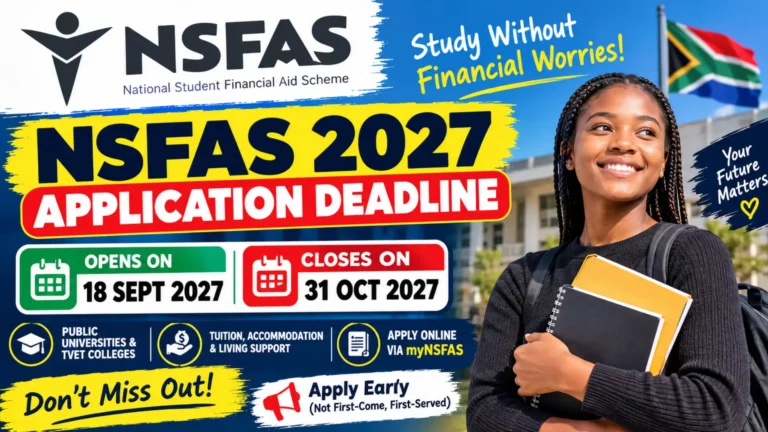
NSFAS 2027 Applications Open: Check How to Apply Online and Deadline
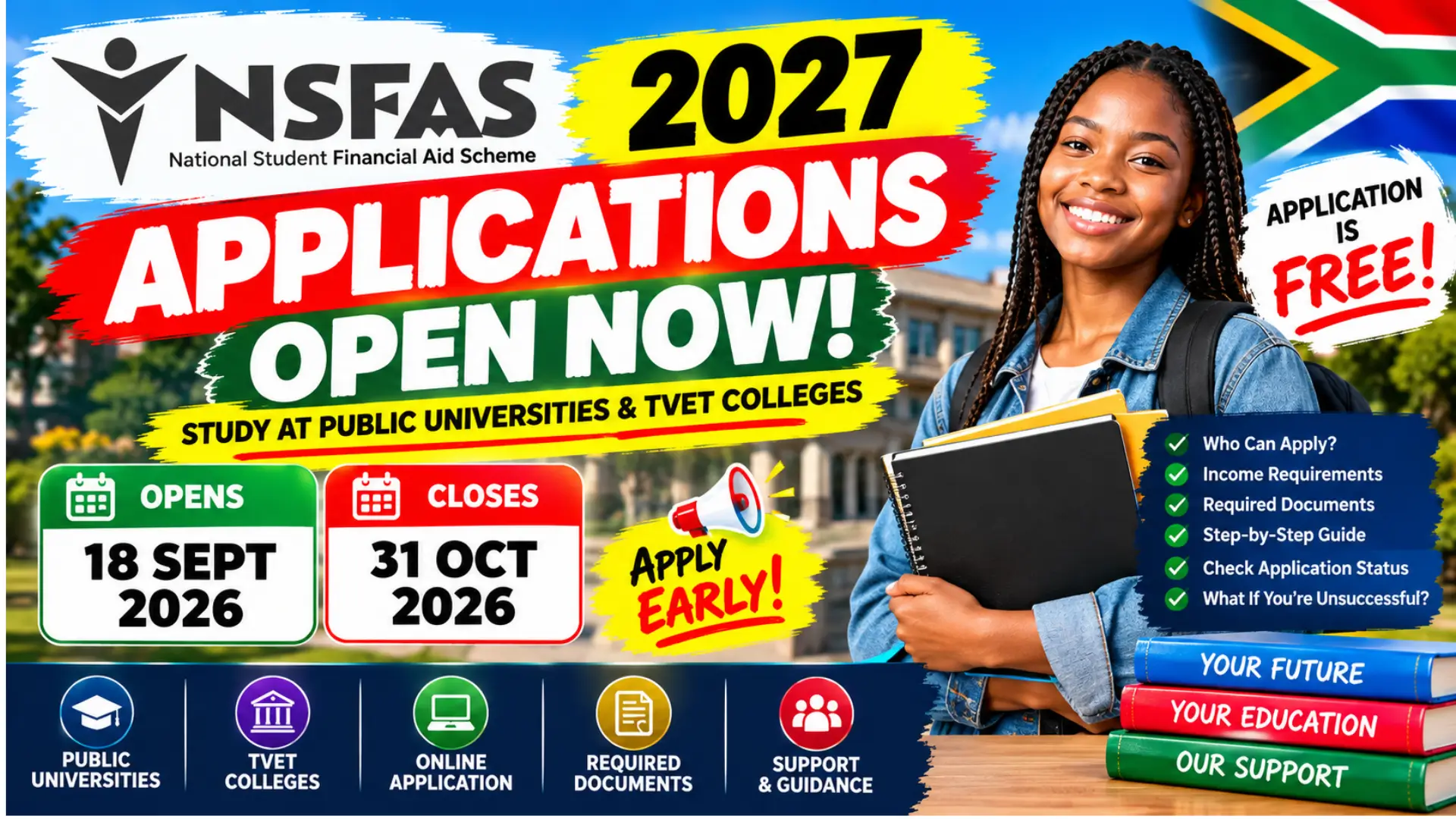
NSFAS 2027 applications are now open for students planning to study at public universities and TVET colleges in South Africa. The application period opened on 18 September 2026, and the current official NSFAS deadline is 31 October 2026. NSFAS has also advised students to apply early rather than waiting until the final days.
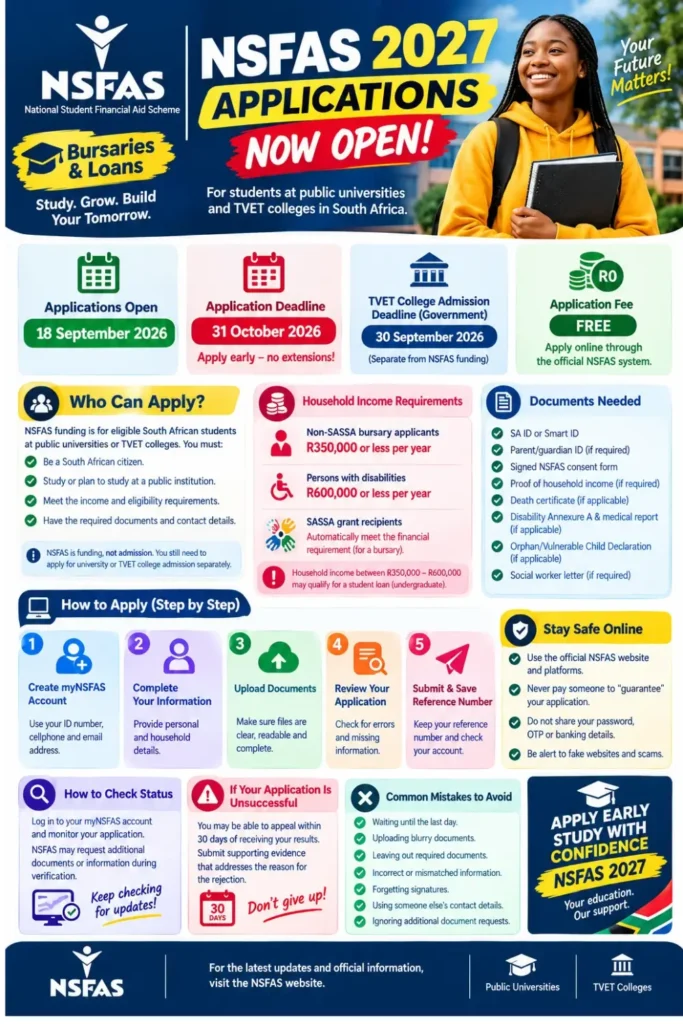
The application itself is free, and students can apply online through the official NSFAS system. The process involves creating a myNSFAS account, providing personal and household information, uploading the required documents, and submitting the application for assessment.
NSFAS 2027 Applications Opening and Closing Date
The NSFAS 2027 application cycle officially opened on 18 September 2026. According to the current NSFAS website, applications will close on 31 October 2026. NSFAS has specifically encouraged prospective students to submit their applications as early as possible.
You can also read: SRD Payment Dates 2026
The response has already been significant. NSFAS reported receiving 51,474 applications within the first four days of the 2027 application cycle, showing how many students are already preparing for the new academic year. NSFAS also said there would be no extension of the application period, so students should not rely on a possible deadline extension.
Important NSFAS 2027 dates
| Important detail | Date / information |
|---|---|
| NSFAS 2027 applications open | 18 September 2026 |
| NSFAS application deadline | 31 October 2026 |
| Public TVET college admission deadline mentioned by government | 30 September 2026 |
| Application fee | Free |
| Application method | Online through NSFAS |
| Application platform | myNSFAS / official NSFAS platforms |
The TVET college admission deadline should not be confused with the NSFAS funding deadline. Applying for admission and applying for NSFAS funding are separate steps. Government guidance has encouraged TVET applicants to apply for admission and then submit a separate NSFAS funding application where financial assistance is needed.
Who Can Apply for NSFAS 2027?
NSFAS funding is intended for eligible South African students who plan to study, or are studying, at qualifying public universities or public TVET colleges. Meeting the basic requirements does not automatically mean funding is approved; NSFAS still has to verify the information provided and assess the application against its funding rules.
You should generally check these points before starting your application:
- You are a South African citizen.
- You plan to study or are studying at a public university or TVET college.
- Your qualification and institution fall within NSFAS funding rules.
- You meet the applicable household-income requirements.
- You have the information and documents required for verification.
- You can provide a working cellphone number and email address.
NSFAS does not mean that you are automatically admitted to an institution. You still need to apply for admission to the university or TVET college separately.
NSFAS 2027 Household Income Requirements
Household income is one of the most important parts of the NSFAS assessment. For non-SASSA applicants seeking a bursary, the current NSFAS information states that gross combined household income must be R350,000 or less per year. For persons with disabilities, the threshold is R600,000 or less per year.
Verified SASSA grant recipients have a different financial eligibility route. NSFAS states that verified SASSA grant recipients automatically meet the financial requirement for a bursary, meaning they do not have to meet the standard R350,000 household-income limit in the same way as non-SASSA applicants.
What if household income is above R350,000?
An applicant who does not fall within the standard bursary income limit should not automatically assume that no NSFAS-related funding option exists. The current NSFAS FAQ says undergraduate applicants with gross combined household income between R350,000 and R600,000 can fall within the income range for the NSFAS student loan, subject to the applicable rules.
A loan is different from a bursary because it is repayable under the relevant loan terms. Therefore, students should check the funding type they are being assessed for rather than assuming that every NSFAS applicant receives a bursary.
You can also read: SRD Payment Dates Tracker
Documents Needed for NSFAS 2027 Applications
Having your documents ready before you start can make the application much easier. NSFAS advises applicants to make sure uploaded documents are clear and readable, with the full page visible. The current official checklist includes identity information, parent or legal guardian information where applicable, consent documentation, and additional documents for specific circumstances.
Your exact document requirements can depend on your personal circumstances. Common documents and forms may include:
- South African ID or Smart ID information.
- ID copies of parents or legal guardians where required.
- Signed and dated NSFAS consent form.
- Parent or legal guardian signature where applicable.
- Proof or information relating to household income when required.
- Death certificate if a parent has passed away.
- Disability Annexure A and a medical report where applicable.
- Orphan or Vulnerable Child Declaration where applicable.
- Supporting letter from a social worker where required.
NSFAS has also warned applicants about document quality. A document that is technically uploaded but cannot be read may still cause problems during verification. Before submitting, open each file and check that the name, ID number, dates and other important information can be clearly seen.
How to Apply for NSFAS 2027 Online
The NSFAS application process is completed online. NSFAS says applying is free and applicants can create a myNSFAS account using their South African ID number, cellphone number and email address. After registration, applicants complete their information, provide consent for verification, upload supporting documents, submit the application and save the reference number.
Here is the process in a straightforward format.
Step 1: Create Your myNSFAS Account
Start by creating your account through the official NSFAS platform. Use your own South African ID information, a working cellphone number and an email address that you can access.
Make sure your contact details are correct. Your cellphone number and email may be important when NSFAS communicates with you about your application or requests additional information.
Step 2: Complete Your Personal Information
After creating your account, log in and complete the information requested in your profile and application.
Take your time with names, surnames, ID details and contact information. Your information should be consistent with your official records because NSFAS verifies applicant information.
Step 3: Enter Your Household Information
The application also requires relevant household and financial information. This section is important because NSFAS uses financial information when determining eligibility.
Do not guess or deliberately change information to try to qualify. Provide accurate information and upload supporting documents where NSFAS requires them.
Step 4: Upload Supporting Documents
Upload the documents that apply to your circumstances. Check each file before submitting it.
A useful final check is:
- The entire document is visible.
- Text is readable.
- The correct document has been uploaded.
- Signatures are present where required.
- The file is not blurry or cut off.
- Names and ID details are consistent.
NSFAS specifically tells applicants to make sure every corner of the page is visible and the text can be read.
Step 5: Review Your Application
Do not rush to press submit. Go through your application once more and look for spelling mistakes, incorrect numbers, missing documents or information that does not match your supporting paperwork.
This small check can save you from unnecessary delays later.
Step 6: Submit and Save Your Reference Number
Once everything is correct, submit your NSFAS 2027 application. After submission, save your application reference number and keep a record of it.
You should also continue checking your myNSFAS account after applying because NSFAS may request additional information or documents during the assessment process.
You can also read: SRD SASSA Payment Dates January
How to Apply for NSFAS 2027 Safely
There are many websites and social-media posts discussing NSFAS applications, but applicants should be careful about sharing personal information. NSFAS states that applications are free and advises applicants to use official NSFAS platforms.
Never pay someone simply because they claim they can guarantee NSFAS funding or speed up your application. Be especially careful with anyone asking for your password, OTP, banking information or other sensitive details.
For the safest route, use the official NSFAS website and its official application channels.
How to Check NSFAS 2027 Application Status
Submitting an application is not the end of the process. After applying, log in to your myNSFAS account and monitor your application status.
The status shown on your account can change as NSFAS processes and verifies your application. If NSFAS asks for additional documents, respond as soon as possible rather than leaving the request unanswered.
Some application outcomes or stages may indicate that your information is still being verified, that documents are required, or that your application has reached a funding-related decision. Always read the message shown in your own myNSFAS account because the action required can differ from one applicant to another.
What If Your NSFAS Application Is Unsuccessful?
An unsuccessful NSFAS application does not necessarily mean the process is finished. Eligible applicants may have an opportunity to appeal a funding decision, depending on the reason for the outcome and the applicable appeal rules.
NSFAS currently states that rejected applicants who are eligible to appeal can submit an appeal within 30 days of receiving their application results. Supporting evidence should address the reason for the rejection rather than simply repeating the original application.
For example, supporting documents may be relevant where there has been a change in household circumstances or where additional evidence is available. The exact documents required depend on the circumstances of the appeal.
Common NSFAS Application Mistakes to Avoid
Many application problems can be avoided by spending a few extra minutes checking your information before submission. A successful account registration alone does not guarantee that the application has been correctly completed.
Watch out for these common mistakes:
- Waiting until the final day to apply.
- Uploading blurry or incomplete documents.
- Leaving required documents out.
- Providing information that does not match official records.
- Forgetting required signatures.
- Using someone else’s contact details.
- Ignoring requests for additional documents.
- Assuming NSFAS funding is the same as university admission.
- Paying an unofficial person to submit an application.
- Sharing your myNSFAS password or OTP.
NSFAS itself recommends applying early and ensuring that required supporting documents and consent forms are submitted correctly.
NSFAS 2027 Application Tips
The easiest way to avoid last-minute pressure is to treat the application as a process rather than something to complete in one sitting. Prepare your documents first, then complete the online form carefully.
A few practical habits can also help:
- Use an email address you check regularly.
- Keep your cellphone number active.
- Save copies of documents you upload.
- Save your application reference number.
- Take screenshots of important confirmation messages for your own records.
- Check your myNSFAS account regularly.
- Respond quickly if additional documents are requested.
- Apply before the deadline instead of waiting for the last day.
The official NSFAS application guidance also recommends creating your account, gathering documents, checking your details and then completing the application through the official system.
NSFAS 2027 Applications: Bursary vs Loan
Not every applicant falls into exactly the same funding category. The standard NSFAS bursary financial threshold for non-SASSA applicants is R350,000 or less in gross combined household income, while persons with disabilities have a R600,000 threshold.
For undergraduate students whose household income falls between R350,000 and R600,000, NSFAS says they may fall within the income range for the student loan. Because a loan has repayment obligations, applicants should understand which funding option applies to them before making assumptions about their future financial responsibilities.
| Funding situation | Current NSFAS information |
|---|---|
| Non-SASSA bursary applicant | Household income up to R350,000 |
| Person with disability | Household income up to R600,000 |
| Verified SASSA grant recipient | Automatically meets the financial requirement |
| Undergraduate household income R350,000–R600,000 | May fall within NSFAS loan income range |
These figures describe the current NSFAS financial criteria and should not be treated as a guarantee of funding. Other eligibility and funding rules can also apply.
Does NSFAS Apply for University Admission Too?
A NSFAS application is a funding application, not an application for admission to a university or TVET college. If you want to study in 2027, you should also follow the admission process of the institution and qualification you are interested in.
In other words, applying for NSFAS does not reserve you a university place. You need to deal with admission and financial aid as two connected but separate parts of your study plan.
You can also read: SRD Status Check September 2026
Frequently Asked Questions
When do NSFAS 2027 applications close?
The current official NSFAS closing date is 31 October 2026. NSFAS has encouraged students to apply early and has stated that there will be no extension of the application period.
When did NSFAS 2027 applications open?
The 2027 NSFAS application cycle opened on 18 September 2026. The official NSFAS website confirms the opening date.
Is the NSFAS application free?
Yes. NSFAS states that applying is free. Be cautious if someone asks you to pay a fee to submit or guarantee your NSFAS application.
Can SASSA recipients apply for NSFAS?
Yes. Verified SASSA grant recipients can apply, and NSFAS states that they automatically meet the financial requirement for a bursary.
What is the NSFAS household income limit?
For non-SASSA applicants seeking a bursary, the current gross combined household-income limit is R350,000 per year. The threshold for persons with disabilities is R600,000 per year.
Can I apply if my household income is above R350,000?
If your gross combined household income is between R350,000 and R600,000, you may fall within the income range for an undergraduate NSFAS student loan, subject to the applicable rules. A loan is repayable, unlike a bursary.
Can I apply for NSFAS at a private college?
NSFAS funding is focused on qualifying public universities and public TVET colleges. Applicants should confirm that their institution and qualification are covered before relying on NSFAS funding.
What happens after I submit my NSFAS application?
NSFAS verifies the information and documents submitted. You should continue checking your myNSFAS account because additional information or documents may be requested during processing.
Conclusion
The NSFAS 2027 application window is already open, so students who need financial assistance should start the process rather than leaving everything until the deadline. The official opening date was 18 September 2026, while the current NSFAS website lists 31 October 2026 as the closing date.
The most important things are simple: use the official application platform, provide accurate information, prepare clear documents, submit before the deadline, and continue checking your account after submission. Applying early also gives you more time to correct problems if NSFAS asks for additional information.
For official application instructions and the latest updates, always verify information directly through NSFAS rather than relying only on social-media posts or unofficial application websites.