NSFAS 2027 Application Deadline: Latest Dates, Requirements & Online Guide
If you are planning to study at a public university or TVET College in South Africa in 2027 and need financial assistance, the NSFAS application deadline is one of the most important dates to know. The National Student Financial Aid Scheme (NSFAS) provides financial support to eligible students who cannot afford the cost of higher education.
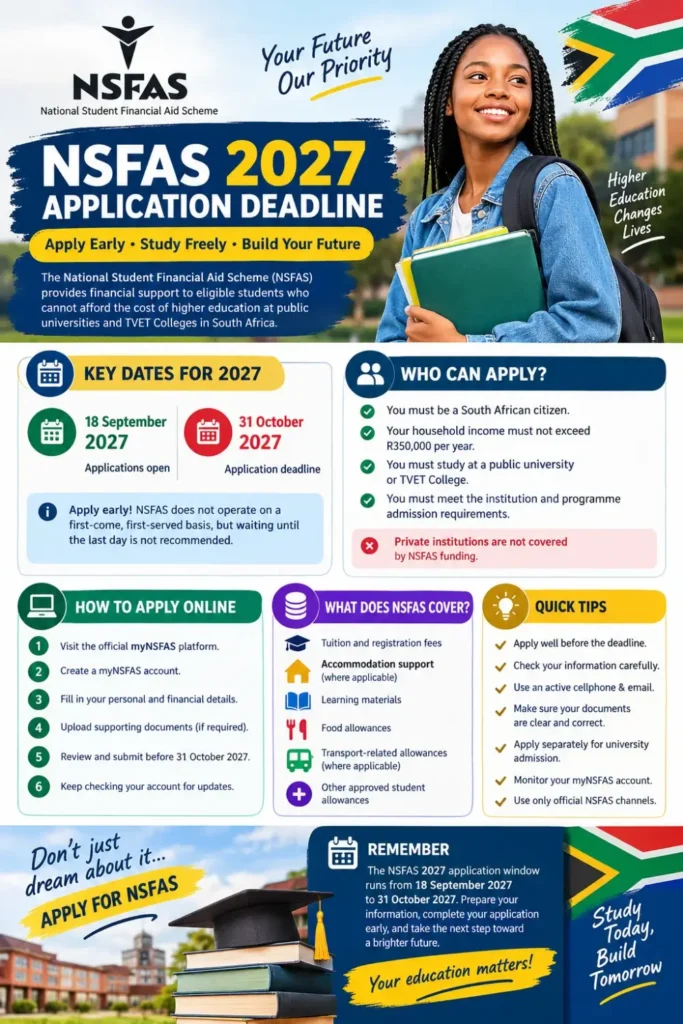
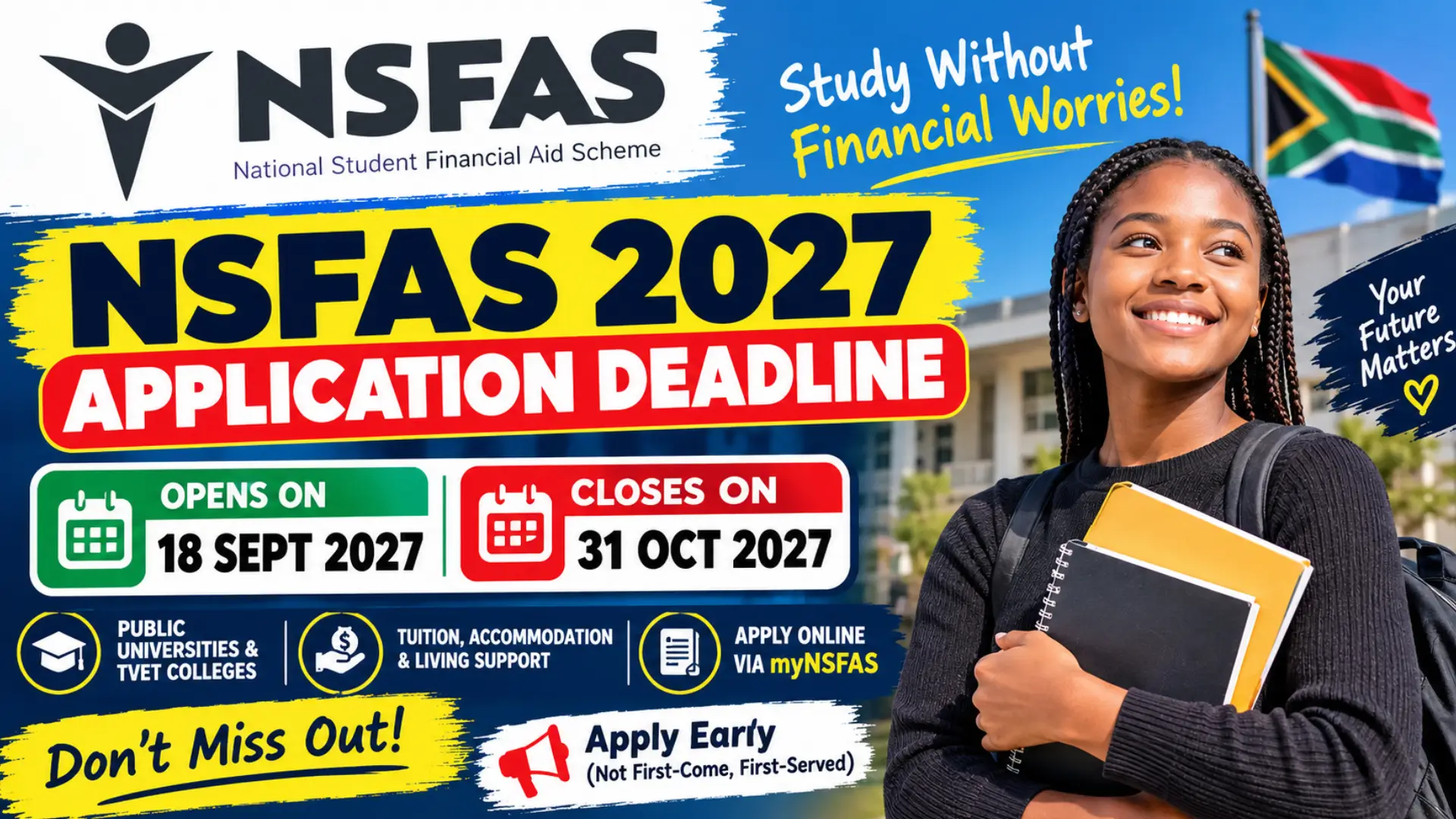
For the 2027 academic year, NSFAS applications are scheduled to open on 18 September 2027 and close on 31 October 2027. Students are encouraged to submit their applications early, although NSFAS does not operate on a first-come, first-served basis.
NSFAS 2027 Application Deadline and Opening Date
The NSFAS 2027 application window is scheduled to run for several weeks, giving students time to prepare their information and complete the online process. According to the announcement provided, applications open on 18 September 2027 and the deadline is 31 October 2027.
| NSFAS 2027 Detail | Information |
|---|---|
| Application opening date | 18 September 2027 |
| Application deadline | 31 October 2027 |
| Academic year | 2027 |
| Application platform | myNSFAS |
| Funding institutions | Public universities and TVET Colleges |
| Private institutions | Not covered |
| Maximum household income stated | R350,000 per year |
Students should avoid waiting until the final days. Applying earlier gives you more time to correct information, respond to requests, or resolve technical problems before the closing date.
Who Can Apply for NSFAS 2027?
NSFAS is designed to support students who need financial assistance to study at South Africa’s public universities and TVET Colleges. The scheme does not provide funding for students studying at private higher education institutions, even where those institutions are accredited.
You can also read: NSFAS 2027 Applications Open
The income requirement is one of the most important parts of the application. Based on the information provided, South African applicants whose household income does not exceed R350,000 per year can apply, subject to the applicable NSFAS rules and assessment.
NSFAS Eligibility Requirements
Before starting an application, students should make sure they meet the basic conditions. Eligibility is not determined by one factor alone, so submitting an application does not automatically mean that funding will be approved.
Key requirements include:
- You must be a South African citizen.
- Your household income must fall within the applicable NSFAS income threshold.
- You must intend to study at an eligible public university or TVET College.
- You must meet the admission requirements of your chosen institution and programme.
- You need to provide the required personal and supporting information during the application process.
- Students at private institutions are not covered by NSFAS funding.
How to Apply for NSFAS 2027 Online
NSFAS applications should be completed through the official myNSFAS online platform. The application process has also been developed with cellphone users in mind, which can make it easier for students who do not have regular access to a computer.
Before applying, make sure your personal information is correct and that you have access to the documents or details that NSFAS may require. Incorrect information can create delays later in the assessment process.
Step-by-Step NSFAS Application Guide
Follow these basic steps when applications are open:
- Visit the official NSFAS application platform.
- Create a myNSFAS account if you do not already have one.
- Enter your personal and contact information carefully.
- Provide the required household and financial information.
- Upload supporting documents if requested.
- Review your application before submitting it.
- Submit the application before 31 October 2027.
- Keep your login details safe so you can check future updates.
After submitting your application, continue checking your myNSFAS account. NSFAS may request additional information or documents during the assessment process.
What Does NSFAS Funding Cover?
NSFAS is more than a tuition-fee support programme. For eligible students, funding can include different forms of financial assistance connected with studying at an approved public institution.
The exact support a student receives can depend on their institution, programme, living arrangements and the applicable funding rules for that academic year.
Generally, NSFAS support may include areas such as:
- Tuition and registration costs
- Accommodation support where applicable
- Learning materials
- Food allowances
- Transport-related allowances where applicable
- Other approved student allowances
Students should check their funding information carefully because allowances and conditions can change according to the official NSFAS rules.
NSFAS 2027 Does Not Cover Private Colleges
One important point students often misunderstand is that NSFAS does not fund private higher education institutions. A college or university being accredited does not automatically make it eligible for NSFAS funding.
The scheme is intended for eligible public universities and TVET Colleges. Therefore, students should confirm that their chosen institution and programme fall under NSFAS before relying on the funding for their studies.
If you are applying to a private institution, you should investigate that institution’s own bursaries, payment plans or other financial-aid options instead of assuming NSFAS will cover the costs.
Do You Need to Apply to a University Separately?
Yes. Applying for NSFAS funding is not the same as applying for admission to a university or TVET College.
This is an important point highlighted by Minister Buti Manamela. Students who want to study in 2027 should apply for admission to their chosen institution as well as applying for NSFAS funding.
In simple terms, you need to handle two separate processes:
| Process | Purpose |
|---|---|
| Institution application | Applies for admission to your chosen course or programme |
| NSFAS application | Applies for financial assistance |
Submitting a NSFAS application does not guarantee admission to a university or TVET College. Likewise, being admitted does not automatically guarantee NSFAS funding.
Is NSFAS First Come, First Served?
No. Students should still apply as early as possible, but NSFAS does not operate on a simple first-come, first-served basis.
This means students who experience technical problems during the first few days should not assume they have lost their chance. They can still submit their application during the official application period.
However, waiting until the final day is not recommended. Technical issues, missing documents or incorrect information can take time to resolve.
You can also read: SASSA R370 Balance Check Online Via Easy Mehtod
Can Older Students Apply for NSFAS?
There is no general age limit preventing students from applying for NSFAS, according to the information provided in the announcement.
In fact, a 72-year-old applicant reportedly set last year’s record, showing that age alone does not necessarily prevent someone from seeking NSFAS support.
Students should therefore focus on the actual eligibility requirements rather than assuming they are too old to apply.
Does Race Affect NSFAS Eligibility?
According to the minister’s announcement, South Africans of all races are eligible to apply for NSFAS funding if they meet the applicable requirements.
Students should therefore not avoid applying because they believe NSFAS funding is restricted to a particular racial group. Eligibility is based on the scheme’s published requirements and the applicant’s circumstances.
Common NSFAS Application Mistakes to Avoid
Many application problems can be avoided by taking a few extra minutes to check your information before submitting. A rushed application can lead to incorrect personal details, missing documents or other issues that may delay the assessment.
Keep these common mistakes in mind:
- Entering an incorrect ID number or personal information.
- Using contact details that you no longer have access to.
- Uploading unclear or incorrect documents.
- Assuming a NSFAS application also counts as a university application.
- Waiting until the deadline to apply.
- Forgetting to check the myNSFAS account after submitting.
- Applying without confirming that the institution is eligible for NSFAS funding.
Tips for a Successful NSFAS 2027 Application
A good application starts with preparation. You do not need to rush through the form simply because applications have opened; instead, make sure your information is accurate and that you understand what you are applying for.
It is also a good idea to keep copies of documents and important application information for your own records. After submitting, regularly monitor your myNSFAS account for messages, requests or changes to your application status.
Best Practices Before Submitting
- Apply well before 31 October 2027.
- Check every personal detail before submission.
- Use an active cellphone number and email address.
- Make sure uploaded documents are readable.
- Save your login information securely.
- Check your application status after submitting.
- Apply separately for admission at your chosen institution.
- Use official NSFAS channels when looking for application information.
What Happens After You Apply?
Submitting the online form is only the beginning of the NSFAS process. Your application needs to go through assessment and verification before a final funding decision can be made.
NSFAS may also request additional information from an applicant. This is why students should not simply submit the application and forget about it. Regularly checking the account can help you respond to requests within the required timeframe.
If your application is unsuccessful, carefully review the reason provided and check whether an appeal option is available under the rules applicable to your situation.
NSFAS 2027 Deadline: Key Dates to Remember
The most important date for prospective 2027 applicants is 31 October 2027. Students should aim to complete the process before this date rather than treating the final day as their target.
Here is the key timeline at a glance:
| Date | What It Means |
|---|---|
| 18 September 2027 | NSFAS 2027 applications open |
| September–October 2027 | Students can submit applications |
| 31 October 2027 | Application window closes |
| After submission | Applications undergo assessment and verification |
Always check the official NSFAS platform for any subsequent changes, announcements or additional instructions.
Frequently Asked Questions About NSFAS 2027
When do NSFAS 2027 applications open?
According to the information provided, NSFAS 2027 applications open on 18 September 2027.
What is the NSFAS 2027 application deadline?
The stated closing date for NSFAS 2027 applications is 31 October 2027.
Where can I apply for NSFAS 2027?
Students should submit their applications through the official NSFAS online platform at my.nsfas.org.za.
Does NSFAS fund private colleges?
No. NSFAS funding is intended for eligible public universities and TVET Colleges and does not cover private institutions.
Is NSFAS first come, first served?
No. NSFAS does not operate on a simple first-come, first-served basis. However, applying early is still recommended so you have enough time to fix problems or provide requested information.
Do I need to apply to university separately?
Yes. A NSFAS funding application does not replace an application for admission to a university or TVET College.
Is there an age limit for NSFAS?
The information provided indicates that there is no general age limit preventing eligible students from applying.
You can also read: NSFAS Status Check Online
Conclusion
The NSFAS 2027 application period is an important opportunity for South African students who need financial assistance to continue their education. The stated application window runs from 18 September 2027 to 31 October 2027, and students should use the official NSFAS platform rather than relying on unofficial application websites.
The safest approach is to prepare your information early, apply before the deadline, separately apply for admission to your chosen institution, and keep checking your myNSFAS account after submission. Taking these simple steps can help you avoid many of the problems students face during the application process.