Sars Digital Vat System Changes Fraud Detection Could improve
South Africa is moving towards a more digital approach to VAT administration, and the proposed changes could significantly alter how businesses record, report and manage VAT. The planned SARS Digital VAT Model is centred on electronic invoicing, digital reporting and greater use of structured transaction data.
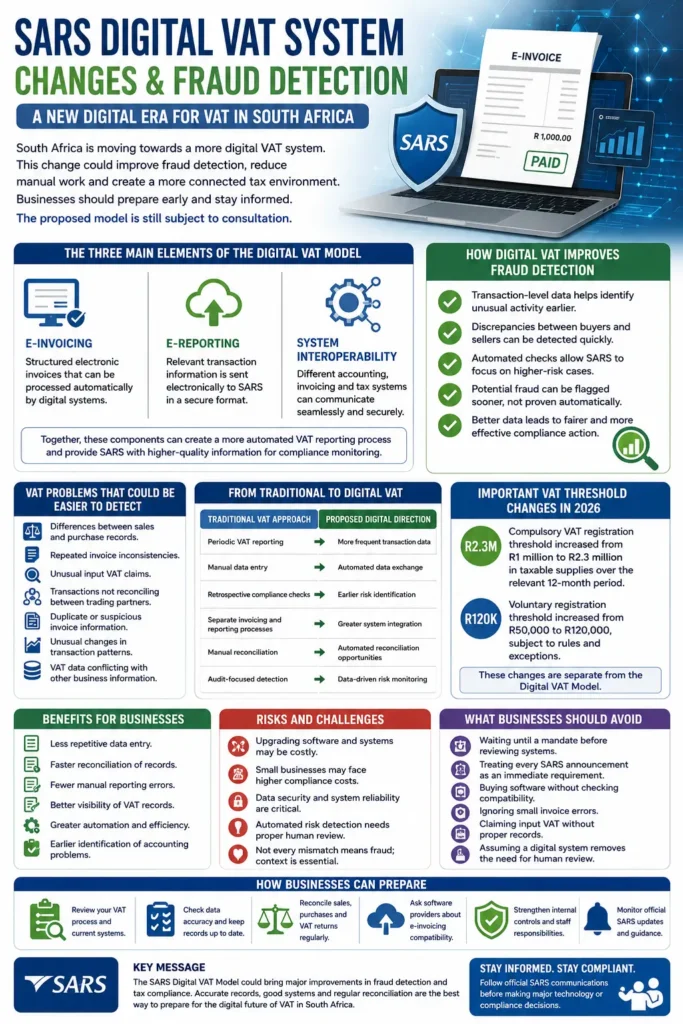
One of the biggest potential advantages is improved VAT fraud detection. Instead of relying mainly on information submitted through periodic VAT returns, SARS could increasingly use transaction-level data to identify unusual activity, inconsistencies and possible fraud much earlier. However, the proposed model is still subject to consultation, so businesses should not treat every proposed feature as an immediate legal requirement.
What Is the SARS Digital VAT System?
The Digital VAT Model is part of SARS’s broader modernisation programme. Its aim is to create a more connected VAT environment in which transaction information can move electronically between businesses, accounting systems, technology providers and SARS.
The long-term direction is toward a system where VAT information is captured closer to the point at which transactions happen. This could reduce duplicate data entry and allow automated checks to take place earlier. SARS previously published a VAT Modernisation Discussion Paper describing its high-level vision for modernising VAT administration, and the current reform continues that digital direction.
The three main elements
The proposed digital approach can broadly be understood through three connected areas:
- E-invoicing: Creating structured electronic invoices that can be processed by digital systems.
- E-reporting: Sending relevant transaction information electronically to SARS.
- System interoperability: Allowing different accounting, invoicing and tax systems to communicate securely.
Together, these components could create a more automated VAT reporting process and give SARS better-quality information for compliance monitoring.
How Could Digital VAT Improve Fraud Detection?
Traditional VAT administration can make it difficult for a revenue authority to identify certain problems immediately because detailed transaction information may only become available through periodic reporting, audits or investigations.
A digital VAT environment could change that. If structured transaction information becomes available to SARS closer to the time of the transaction, automated systems could compare information across businesses and identify discrepancies without waiting for a traditional audit.
For example, where a supplier records a taxable sale but the corresponding information does not match the purchaser’s records, the difference could potentially become a compliance signal. That does not automatically mean fraud has occurred, but it could help SARS decide which transactions or taxpayers require further attention.
What Types of VAT Problems Could Be Easier to Detect?
Digital transaction data could make certain patterns more visible to SARS. The technology would not necessarily prove that a taxpayer committed fraud, but it could help identify transactions that deserve additional review.
Potential risk indicators could include:
- Differences between sales and purchase records.
- Repeated invoice inconsistencies.
- Unusual input VAT claims.
- Transactions that do not reconcile between trading partners.
- Duplicate or suspicious invoice information.
- Unusual changes in transaction patterns.
- VAT information that conflicts with other available business data.
The important point is that digital detection is not the same as automatic prosecution or an automatic audit. A flagged transaction would generally need appropriate review and context before SARS could determine whether an actual compliance failure exists.
Why E-Invoicing Matters for VAT Compliance
E-invoicing is likely to be one of the most important parts of the digital VAT transformation. Instead of businesses manually moving information from invoices into accounting and VAT systems, structured invoice data can potentially be processed automatically.
This can reduce transcription errors and make reconciliation easier. It also creates information that can be analysed electronically, allowing tax authorities to perform more sophisticated compliance checks.
From periodic reporting to transaction-level information
The major change is the potential movement away from a system dominated by retrospective VAT reporting towards more continuous digital information flows.
| Traditional VAT approach | Proposed digital direction |
|---|---|
| Periodic VAT reporting | More frequent transaction data |
| Manual data entry | Automated data exchange |
| Retrospective compliance checks | Earlier risk identification |
| Separate invoicing and reporting processes | Greater system integration |
| Manual reconciliation | Automated reconciliation opportunities |
| Audit-focused detection | Data-driven risk monitoring |
This does not mean that every South African business is already required to send every invoice to SARS in real time. The proposed model still requires further development, consultation and implementation decisions.
Could SARS Detect Fraud Earlier?
Potentially, yes. Near-real-time or frequent access to structured transaction data could allow SARS to identify inconsistencies much sooner than a system that depends mainly on periodic VAT declarations.
Consider a simple example. A business claims a large amount of input VAT from purchases, but the corresponding supplier-side transaction data does not appear to support the claim. Under a more connected system, that discrepancy could potentially be identified earlier and assessed as a risk indicator.
This could allow SARS to focus investigative resources on higher-risk cases rather than relying exclusively on broad retrospective audits.
Digital VAT Could Also Help Honest Businesses
It would be a mistake to view the proposed system only as a fraud-control mechanism. Properly implemented, digital VAT could also benefit businesses that want to remain compliant.
Automated processes could reduce repetitive administrative work and make it easier to reconcile invoices, accounting records and VAT information. SARS’s broader modernisation strategy is also aimed at making compliance easier and improving the taxpayer experience.
For businesses with reliable accounting systems, the shift could eventually mean fewer manual processes and faster identification of genuine errors before they become larger compliance problems.
What Does This Mean for Small Businesses?
Small and medium-sized businesses should pay particular attention to the development of the Digital VAT Model. The effect will depend on the final technical requirements, implementation timetable and whether different businesses are brought into the system in phases.
You can also read: Sassa 370 Whatsapp Number 2026
Businesses using modern cloud accounting or invoicing software may find it easier to adapt. Smaller companies relying on basic spreadsheets or older systems could face additional technology and training costs if digital reporting requirements eventually become mandatory.
Small businesses should start preparing
Businesses can take practical steps now without waiting for a final mandate:
- Review the accounting and invoicing software currently being used.
- Make sure VAT invoices contain accurate information.
- Reconcile sales records with VAT returns regularly.
- Keep supplier and customer information up to date.
- Check that input VAT claims have proper supporting documentation.
- Ask software providers about future e-invoicing compatibility.
- Keep employees responsible for VAT informed about SARS developments.
Preparation is different from immediately buying new technology. Businesses should avoid expensive upgrades based solely on speculation before SARS confirms final technical requirements.
Important VAT Threshold Changes Already Apply in 2026
The proposed digital reforms come at a time when South African businesses are already adjusting to significant VAT changes.
From 1 April 2026, the compulsory VAT registration threshold increased from R1 million to R2.3 million in taxable supplies over the relevant 12-month period. The voluntary registration threshold increased from R50,000 to R120,000, subject to the applicable rules and exceptions.
These threshold changes are separate from the proposed Digital VAT Model. Businesses should therefore avoid combining the two issues and assuming that a change in the registration threshold automatically means a business must adopt digital invoicing.
Will Every Business Have to Use E-Invoicing Immediately?
No. This is one of the most important points businesses should understand.
The Digital VAT Model is a proposed modernisation direction, and its detailed implementation requirements and timelines need to be confirmed. Businesses should distinguish between an announced legal requirement and a proposal being developed through consultation.
Some planning material indicates that implementation is expected to be phased, with larger VAT taxpayers and priority sectors potentially receiving attention first. However, businesses should wait for official SARS communications before treating a particular technology, reporting frequency or connection method as mandatory.
What Are the Benefits of Digital VAT?
If implemented effectively, digital VAT could provide benefits for both SARS and taxpayers.
For businesses, potential advantages include:
- Less repetitive data entry.
- Faster reconciliation.
- Fewer manual reporting errors.
- Better visibility of VAT records.
- Greater automation.
- Earlier identification of accounting problems.
- More consistent compliance processes.
For SARS, the major advantage is better-quality transaction data that can support risk analysis and fraud detection.
You can also read: SRD Status Payment Dates September
What Are the Risks and Challenges?
Digitalisation does not automatically guarantee a better tax system. The implementation itself will be critical.
Businesses could face costs when upgrading software, integrating systems or training employees. Smaller businesses may have fewer resources to make those changes. There are also important questions around data security, system reliability, interoperability and the treatment of genuine invoice errors.
Another challenge is ensuring that automated risk detection does not treat every data mismatch as evidence of wrongdoing. Businesses can have legitimate reasons for differences between records, including timing issues, credit notes, cancellations and corrections.
Common Mistakes Businesses Should Avoid
The move towards digital VAT makes accurate underlying records even more important. A sophisticated reporting system cannot compensate for poor accounting data.
Businesses should avoid:
- Waiting until a mandate is introduced before reviewing their systems.
- Treating every SARS announcement as an immediate legal requirement.
- Buying software without checking its compatibility and support.
- Ignoring small invoice errors because they appear insignificant.
- Claiming input VAT without proper supporting records.
- Assuming a digital system eliminates the need for human review.
- Failing to reconcile accounting records with VAT returns.
Good digital compliance begins with good financial records.
How Businesses Can Prepare for the SARS Digital VAT Changes
Preparation should focus on data quality rather than simply purchasing new software. A business that has accurate invoices, organised records and reliable accounting processes will generally be in a stronger position when digital requirements expand.
A practical preparation checklist
- Review your VAT process – Understand how invoices move from sales and purchases into your accounting records and VAT return.
- Check data accuracy – Verify VAT numbers, supplier information, invoice dates, amounts and tax calculations.
- Test reconciliation – Regularly compare VAT returns against accounting and transaction records.
- Review software capability – Ask your accounting or invoicing provider about structured electronic invoicing and future SARS integration.
- Improve internal controls – Make sure employees understand who approves invoices, claims input VAT and submits returns.
- Monitor SARS announcements – Follow official updates before making major technology or compliance decisions.
You can also read: Petrol Prices August 2026 in South Africa
SARS Digital VAT Changes and Fraud Detection: What Could Change?
The biggest potential change is the amount and speed of information available to SARS.
A more connected VAT environment could allow the revenue authority to compare transaction information across businesses, identify unusual patterns and focus resources on higher-risk cases. This could make VAT fraud more difficult to hide for extended periods.
At the same time, legitimate businesses could benefit if the system reduces manual compliance work and helps identify ordinary errors earlier. The outcome will depend on how accurately the system distinguishes genuine compliance risks from normal business discrepancies.
What Businesses Should Watch Next
The next important developments will be the outcome of consultations and the publication of clearer technical and implementation requirements. Businesses should pay attention to official SARS information rather than relying on social media claims or software vendors making unsupported promises about deadlines.
SARS’s existing VAT guidance confirms that the 2026 VAT registration thresholds are already in effect, while the broader digital VAT transformation remains a separate modernisation process.
Conclusion
The proposed SARS Digital VAT system changes could represent a major step towards more automated tax administration in South Africa. E-invoicing, e-reporting and structured transaction data could give SARS greater visibility of VAT activity and improve the ability to identify suspicious transactions.
For businesses, the message is not to panic but to prepare. Accurate records, reliable accounting systems, proper VAT controls and regular reconciliation will become increasingly important as tax administration becomes more digital.
Most importantly, businesses should remember that the Digital VAT Model is a proposed reform, not a reason to assume that every new digital requirement is already compulsory. The final rules, implementation phases and technical obligations will determine exactly how the system affects South African businesses.
Official SARS VAT information: SARS VAT guidance and updates
