Nsfas T2 Application Through myNSFAS Portal

The 2026 NSFAS TVET Trimester 2 application window is officially open, giving eligible South African students another chance to secure funding for their studies through the myNSFAS portal. Students enrolled or planning to enroll at public TVET colleges can now submit their applications before the closing date of 18 May 2026.
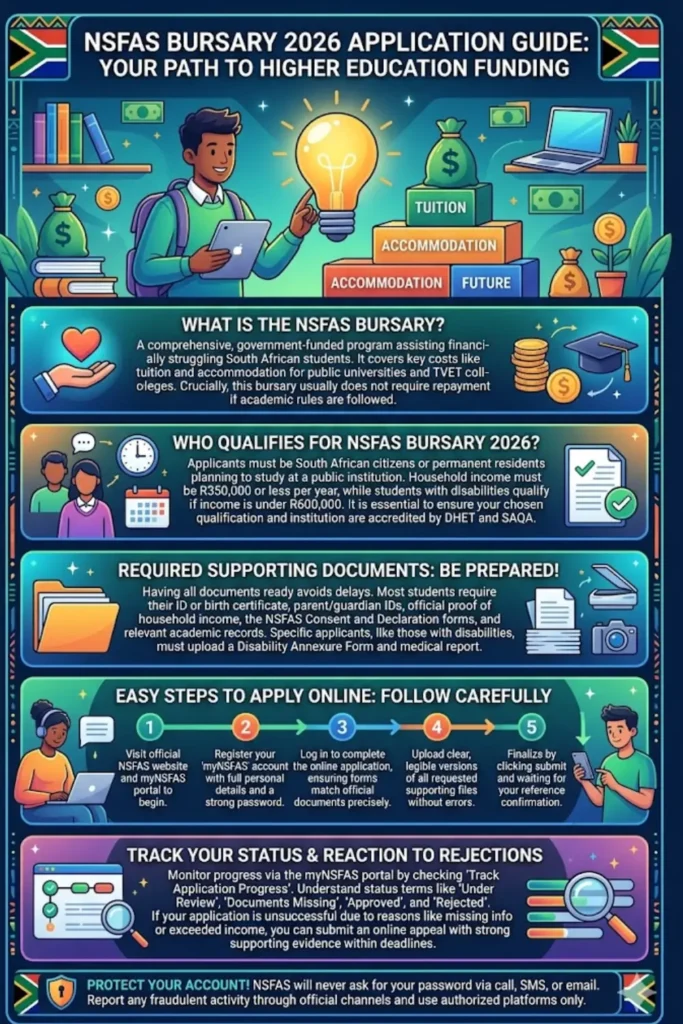
For many students from low-income and working-class households, the National Student Financial Aid Scheme (NSFAS) continues to be one of the most important education support systems in South Africa. Through the myNSFAS portal, applicants can apply online, upload documents, track application status, and manage their funding process from one platform.
How to Apply for NSFAS T2 Through myNSFAS Portal
Applying through the myNSFAS portal is a fully online process designed to make applications easier and faster for students. The portal allows applicants to create accounts, submit documents, and monitor updates without visiting NSFAS offices physically.
You can also read: Sasa Grant Srd Ngesizulu Whatsapp
Students are encouraged to apply early to avoid system delays, upload errors, and last-minute technical problems. Late applications are usually not accepted once the deadline closes.
NSFAS 2026 T2 Application Opening and Closing Dates
Below is the most important timeline students should remember for the 2026 TVET Trimester 2 application cycle.
| Application Process | Date |
|---|---|
| NSFAS T2 Applications Open | May 2026 |
| NSFAS T2 Closing Date | 18 May 2026 |
| Funding Cycle | TVET Trimester 2 |
| Application Method | Online via myNSFAS Portal |
Students should not wait until the final day because heavy traffic on the portal can slow down submissions.
Who Qualifies for NSFAS T2 Funding?
The Trimester 2 application cycle is specifically meant for TVET College students. University students and occupational programme applicants are not included in this intake.
To qualify for NSFAS funding, applicants generally need to meet the following requirements:
- Be a South African citizen or permanent resident
- Be registered or planning to register at a public TVET College
- Be financially eligible according to NSFAS household income rules
- Apply for approved Trimester 2 programmes
- Have household income below R350,000 per year
- Students with disabilities may qualify with household income up to R600,000
Students who already receive NSFAS funding may also need to confirm their academic progression requirements to continue receiving support.
What Is the myNSFAS Portal?
The myNSFAS portal is the official online platform used by NSFAS applicants and funded students. It allows users to complete almost every funding-related task digitally.
Through the portal, students can:
- Create NSFAS accounts
- Submit new funding applications
- Upload supporting documents
- Track application progress
- View funding status updates
- Update personal information
- Receive NSFAS notifications
The platform helps students manage their funding process more efficiently without paperwork delays.
Step-by-Step Guide to NSFAS T2 Application Through myNSFAS Portal
Step 1: Visit the Official NSFAS Website
Students must start by visiting the official NSFAS website and accessing the myNSFAS portal. Always use the official website to avoid scams or fake application platforms.
Once on the website, click on the “myNSFAS” option to either create an account or log in.
Step 2: Create a myNSFAS Account
New applicants must register for a myNSFAS account before applying. Existing users can simply log in with their username and password.
You will usually need:
- South African ID number
- Active cellphone number
- Working email address
- Personal details
After registration, NSFAS may send an OTP verification code to activate your account.
Step 3: Complete the NSFAS Online Application Form
After logging into your account, select the 2026 TVET Trimester 2 application option and complete all required fields carefully.
Students should ensure that:
- Personal information matches official documents
- Academic details are accurate
- Contact information is active and correct
- Financial information is truthful
Incorrect information can delay approval or lead to rejection.
Step 4: Upload Supporting Documents
Applicants must upload all required supporting documents before submission. Documents should be clear, readable, and properly certified where required.
Commonly requested documents include:
- Certified copy of South African ID
- Parent or guardian ID copies
- Proof of household income
- Consent forms
- Disability documents (if applicable)
- Academic records or registration proof
Blurred or incomplete uploads are one of the biggest reasons for processing delays.
tep 5: Submit Your NSFAS Application
Once all sections are complete, review the application carefully before clicking submit. Students should double-check every uploaded document and personal detail.
After submission, applicants will receive confirmation through SMS, email, or the myNSFAS portal dashboard.
You can also read: SASSA Old-Age Grants
What NSFAS Funding Covers for TVET Students
NSFAS funding is designed to reduce financial pressure on students so they can focus on their studies and practical training.
Depending on eligibility, funding may cover:
- Tuition fees
- Accommodation allowance
- Transport allowance
- Learning material allowance
- Personal care allowance
The exact allowance structure may vary depending on accommodation type and college arrangements.
Common NSFAS Application Mistakes to Avoid
Many applications are delayed or rejected because students make avoidable mistakes during the process. Careful preparation can improve approval chances significantly.
Avoid these common problems:
- Applying after the closing date
- Uploading unclear documents
- Using incorrect ID numbers
- Providing false information
- Forgetting to submit the application
- Ignoring NSFAS status updates
- Applying for non-qualifying programmes
Students should regularly log into the myNSFAS portal to monitor notifications and respond quickly if additional documents are requested.
How to Check Your NSFAS Application Status
After submission, students can track their application directly through the myNSFAS portal. This helps applicants stay updated on verification progress and funding decisions.
Common application statuses may include:
| NSFAS Status | Meaning |
|---|---|
| Application Submitted | NSFAS received your application |
| Filtering | Eligibility checks are underway |
| Verification | Documents are being reviewed |
| Funding Eligible | You qualify for funding |
| Approved | Funding approved successfully |
| Unsuccessful | Application not approved |
Checking your status regularly helps avoid missing important updates or document requests.
Important Tips for Faster NSFAS Approval
Students who prepare properly often experience smoother application processing and fewer delays.
Helpful tips include:
- Apply as early as possible
- Use a stable internet connection
- Keep certified documents ready
- Use accurate contact details
- Save copies of uploaded documents
- Check emails and SMS regularly
- Avoid multiple applications
Using only official NSFAS platforms also protects students from scams and fake agents.
Can University Students Apply During the T2 Cycle?
No, the 2026 Trimester 2 application window is strictly for TVET College students only. University applications are not accepted during this specific intake period.
NSFAS has confirmed that occupational programme applications and additional intakes are expected during later application windows, including Semester 2 and future TVET intakes.
Why NSFAS Funding Is Important for TVET Students
TVET colleges play a major role in developing practical skills needed in South Africa’s economy. Many industries rely heavily on technically trained graduates from vocational education institutions.
NSFAS funding allows students to access opportunities in fields such as:
- Engineering
- Information Technology
- Construction
- Hospitality
- Agriculture
- Business Studies
- Manufacturing
By supporting TVET education, NSFAS contributes to skills development, employability, and economic growth across the country.
Conclusion
The NSFAS 2026 TVET Trimester 2 application period gives eligible students an important opportunity to secure financial support for their studies. Through the myNSFAS portal, the application process has become more accessible, faster, and easier to manage online.
You can also read: The Shocking Truth Behind Petrol Prices in South Africa
Students planning to study at a public TVET college should apply before the official closing date of 18 May 2026. Applying early, uploading correct documents, and monitoring application updates can greatly improve the chances of successful funding approval.
