NSFAS Documents Needed for Application 2027 Check SASSA Recipients and Age Restriction

Applying for NSFAS funding in 2027 requires careful preparation of documents. Many applications get rejected simply because documents are missing, outdated, or not properly certified. This guide explains everything in a clear and simple way so you can submit a complete and successful application.
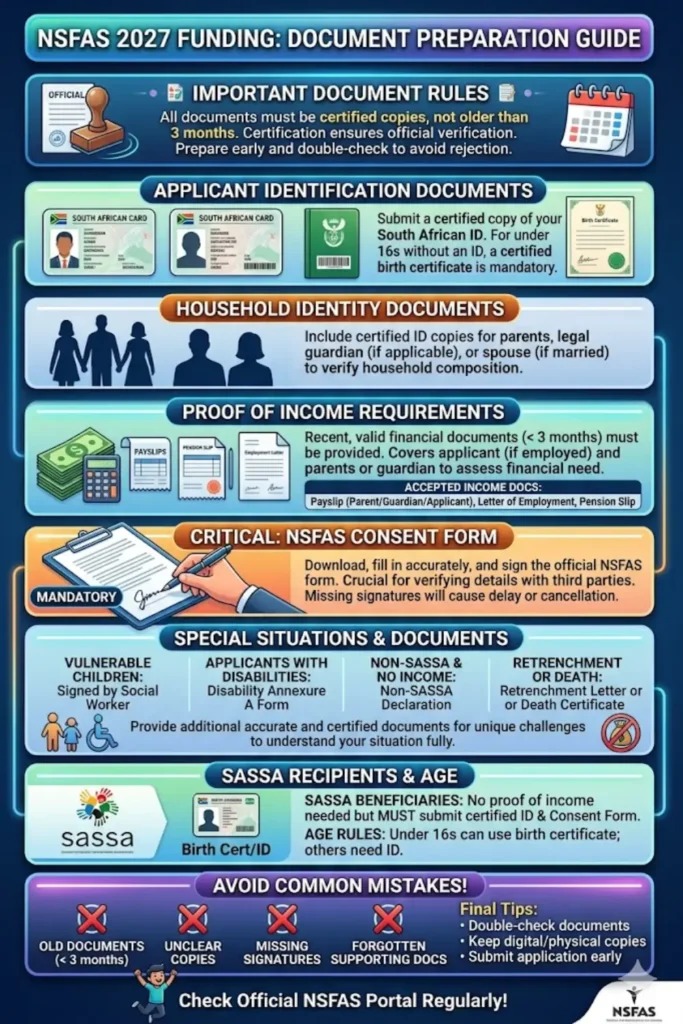
The goal is to help you understand exactly what is needed, who must submit which documents, and how special situations like SASSA grants or age restrictions affect your application.
Understanding NSFAS Document Requirements for 2027
Before applying, it’s important to know that NSFAS verifies your personal and financial information through the documents you submit. Each document plays a role in confirming your identity, household background, and financial need.
All documents must be certified copies not older than 3 months. Certification ensures that your documents are officially verified and accepted by NSFAS. If documents are unclear or outdated, your application may be rejected without review.
Make sure you prepare your documents early and double-check everything before uploading. This avoids last-minute stress and improves your chances of approval.
You can also read: NSFAS Funding Relief if you Want to Enter University
Mandatory Documents for NSFAS Application
Every applicant must submit a standard set of documents. These are compulsory, regardless of your personal situation.
Applicant Identification Documents
Your identity document is the most important requirement. It confirms your eligibility as a South African applicant.
- Certified copy of your South African ID
- Green bar-coded ID or Smart ID card
- If using Smart ID, include both front and back sides
If you are under 16 and do not yet have an ID, you must provide a certified copy of your birth certificate instead.
Household Identity Documents
NSFAS also needs to verify your household members to assess financial need.
- Certified ID copies of parents
- Legal guardian’s ID (if applicable)
- Spouse’s ID (if married)
These documents help NSFAS understand your family structure and income sources.
Proof of Income Requirements
Proof of income is required to determine whether you qualify financially. This applies to both the applicant and their household.
You must provide recent and valid financial documents that reflect your current situation. These documents must not be older than 3 months.
Accepted Proof of Income
- Latest payslips
- Letter of employment
- Pension or retirement slips
- Income proof for parents or guardian
If you are employed, your own proof of income must also be included.
Accepted Income Documents and Conditions
| Document Type | Who Must Submit | Validity Requirement |
|---|---|---|
| Payslip | Parent/Guardian/Applicant | Not older than 3 months |
| Letter of Employment | Parent/Guardian/Applicant | Must be recent |
| Pension Slip | Retired Parent/Guardian | Not older than 3 months |
Ensure that all income documents are clear, readable, and properly certified.
NSFAS Consent Form Importance
The consent form is a critical part of your application. Without it, NSFAS cannot verify your personal and financial details with third parties.
You must complete and sign the form correctly. Any missing signature or incorrect information can delay or cancel your application.
- Download the official NSFAS consent form
- Fill in accurate personal details
- Ensure all required signatures are included
This document allows NSFAS to legally check your financial background.
You can also read:
Special Circumstances Documents
Some applicants need to provide additional documents depending on their situation. These documents help NSFAS understand unique challenges.
For Vulnerable Children or Orphans
- Completed Vulnerable Child Declaration form
- Must be signed by a social worker
For Applicants with Disabilities
- Disability Annexure A Form
- Must be fully completed and signed
For Non-SASSA Applicants Without Income Proof
- Non-SASSA Declaration form
- Confirms lack of formal income
For Retrenchment or Death Cases
- Retrenchment letter (if a parent lost a job)
- Death certificate (if a parent or guardian is deceased)
These documents must be accurate and officially certified to be accepted.
SASSA Recipients: What You Need to Know
If you receive a SASSA grant, your application process becomes simpler. NSFAS already has access to your financial status through the system.
You are not required to submit proof of income if you are a SASSA beneficiary. However, this does not mean you can skip other documents.
You still need to submit:
- Certified copy of your ID
- Completed and signed consent form
Make sure your SASSA information is correct and matches your application details.
You can also read: How to Check Pending Appeal 2026 & Check Full Details
Age Restriction and Special Cases
Age plays an important role in determining which documents you need to submit. NSFAS has clear rules for younger applicants.
If you are under 16 years old:
- You can use a birth certificate instead of an ID
- The certificate must be certified
Older applicants must always provide a valid South African ID. There are no exceptions unless officially stated.
Understanding these rules helps prevent delays or rejections during processing.
Certification Rules and Common Mistakes
Certification is often overlooked, but it is essential for document approval. All documents must be certified by approved authorities.
Accepted certification authorities include:
- South African Police Service (SAPS)
- South African Post Office
Common Mistakes to Avoid
- Submitting documents older than 3 months
- Uploading unclear or blurry copies
- Missing signatures on forms
- Forgetting required supporting documents
Avoiding these mistakes can significantly improve your chances of approval.
You can also read: SASSA SRD Status Pending Details
Conclusion
Preparing your NSFAS application properly can save time and prevent rejection. Always review your documents carefully before submission.
- Double-check all required documents
- Ensure everything is certified and up to date
- Keep digital and physical copies ready
- Submit your application early
Most importantly, regularly check the official NSFAS portal during the application period to stay updated on any changes.
