How to Check South Africa Fuel Under-Recovery Update 2026

South Africa’s fuel market is heading into October 2026 with a major price increase on the cards. The latest Central Energy Fund (CEF) data shows a large fuel under-recovery, meaning the current regulated prices are below the level suggested by international fuel costs and other pricing factors.
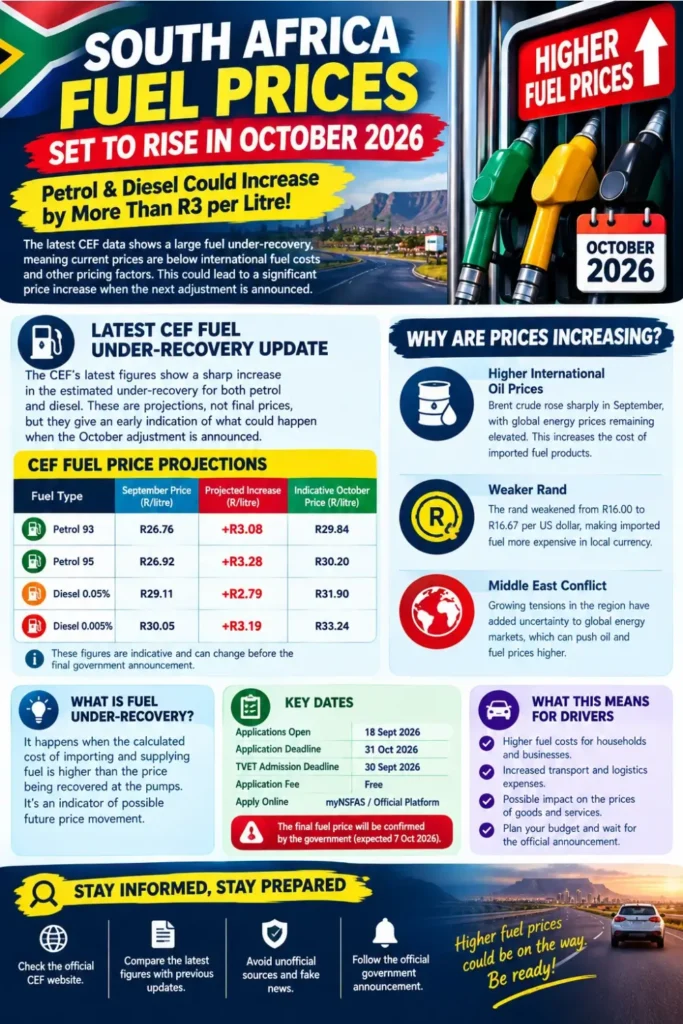
At the start of October, the estimated under-recovery points to an increase of more than R3 per litre for petrol and close to R3 per litre or more for diesel. nsfas status check using id number These are still projections rather than the final prices, but they give motorists an early indication of what could happen when the next monthly fuel adjustment is announced.
What Is Fuel Under-Recovery in South Africa?
Fuel under-recovery is a useful way of understanding whether South Africa’s current fuel prices are keeping pace with changes in international markets. The country’s Basic Fuel Price (BFP) is influenced heavily by international petroleum product prices and the rand-to-US-dollar exchange rate.
When the calculated cost of importing and supplying fuel is higher than the price being recovered at the pumps, an under-recovery occurs. In simple terms, fuel is costing more under the pricing formula than the current regulated price is recovering.
You can also read: Sasa Grant Srd Ngesizulu Whatsapp
An under-recovery does not automatically mean that motorists will see exactly the same increase at petrol stations. nsfas status check using id number 2026 The CEF’s figures are an indicator of the movement in fuel prices, while the final monthly adjustment is determined through the official government process.
Latest South Africa Fuel Under-Recovery Update for October 2026
The latest CEF figures at the beginning of October show a particularly large movement in both petrol and diesel. Petrol 93 is showing an estimated under-recovery of R3.08 per litre, while Petrol 95 is showing an even larger movement of R3.28 per litre.
Diesel is also under significant pressure. The projected increase is R2.79 per litre for 0.05% diesel and R3.19 per litre for 0.005% diesel. These figures can still change before the official adjustment is announced.
Latest CEF Fuel Price Projections
| Fuel Type | September Price | Projected Increase | Indicative October Price |
|---|---|---|---|
| Petrol 93 | R26.76 | +R3.08 | R29.84 |
| Petrol 95 | R26.92 | +R3.28 | R30.20 |
| Diesel 0.05% | R29.11 | +R2.79 | R31.90 |
| Diesel 0.005% | R30.05 | +R3.19 | R33.24 |
These figures should be treated as indicative projections, not guaranteed pump prices. The final amount can move before the government confirms the October adjustment.
Why Are Petrol and Diesel Prices Increasing?
The biggest factor behind the current movement is the international price of oil and petroleum products. South Africa imports a large portion of its energy requirements, so international market movements can quickly affect the country’s domestic fuel pricing formula.
The rand also plays an important role because international oil prices are generally quoted in US dollars. When the rand weakens, South African importers need more rand to purchase the same amount of fuel or crude oil. nsfas status check using id number login
Higher International Oil Prices
International crude oil prices rose sharply during September. Brent crude moved from around $86 per barrel in late August to approximately $108 per barrel by 14 September, before fluctuating at elevated levels later in the month.
For South African motorists, the important point is not simply the headline crude oil price. The country’s fuel pricing system also considers international petroleum product prices, which can move differently from crude oil itself.
The recent increase in global energy prices has therefore created a significant under-recovery in the Basic Fuel Price.
A Weaker Rand Adds Pressure
The rand also weakened during the period under review, moving from roughly R16 per US dollar to R16.67 per US dollar.
Because international fuel costs are linked to the US dollar, a weaker rand can make imported fuel more expensive in local currency. In this particular calculation, however, the exchange-rate movement was contributing only a very small over-recovery compared with the much larger impact coming from international product prices.
Middle East Conflict Creates More Uncertainty
Geopolitical developments in the Middle East are another major factor behind the current volatility. Concerns about a wider conflict involving Iran and the United States have increased uncertainty in global energy markets.
The possibility of attacks on energy infrastructure or disruption to oil supplies can cause traders to push crude and fuel prices higher. This is why a major development in the conflict could still change the CEF’s projected numbers before the official October adjustment.
You can also read: Sars Tax Return 2026 Status Check Online
How to Check the CEF Fuel Under-Recovery Update
Checking the latest under-recovery figures is relatively straightforward, but it is important to use current information because the numbers can change from one update to another.
The Central Energy Fund publishes information used to track fuel price movements. Motorists should compare the latest figures with the previous update rather than relying on an old screenshot or social media post.
Follow These Steps
- Go to the official CEF website and look for its fuel price information.
- Check the latest daily or monthly fuel price data available for the current period.
- Look at the petrol and diesel under-recovery figures separately.
- Compare the latest movement with previous updates to see whether the expected increase is growing or falling.
- Check the official government announcement before treating any projected amount as the final pump price.
A CEF under-recovery figure is most useful when you want an early indication of where fuel prices could be heading. It should not be confused with the final regulated price announced by the authorities.
CEF Under-Recovery vs Official Fuel Price
One of the most common sources of confusion is treating a CEF projection as an official fuel price announcement. The CEF data shows the estimated movement based on the applicable pricing factors, while the final adjustment goes through the official government process.
For October 2026, the figures available at the beginning of the month indicate a possible increase of more than R3 per litre for some fuel grades. However, the final price can differ if international oil prices, fuel product prices or the rand exchange rate move before the adjustment date.
The official adjustment is expected to take effect on Wednesday, 7 October 2026, according to the information provided for this update. Motorists should therefore check the final government announcement before making financial decisions based on the projected figures.
What Could Change the October 2026 Fuel Price?
There is still room for the final numbers to change. Fuel pricing is affected by international markets, and conditions can move quickly, particularly when oil markets are responding to geopolitical developments.
The main factors to watch before the final announcement include:
- Brent crude oil prices
- International petrol and diesel product prices
- Rand/US dollar exchange rate
- Developments in the Middle East
- Changes in global oil supply expectations
- Other adjustments included in South Africa’s fuel pricing system
A sudden drop in oil prices could reduce the expected increase, while another major jump in energy prices could push the under-recovery higher.
What the Expected Increase Means for South African Drivers
If the projected increases were implemented in full, motorists would face a significant rise in the cost of filling their vehicles. Petrol 95, for example, would move from the September price of R26.92 to an indicative R30.20 per litre based on the current projection.
The impact would not be limited to private motorists. Diesel is widely used by commercial vehicles, freight operators, agriculture and other businesses. Higher diesel costs can therefore increase transportation and operating expenses, which may eventually place additional pressure on the prices of goods and services.
Why Drivers Should Watch the Final Price
A difference of even a few cents per litre becomes meaningful when a vehicle has a large fuel tank or is used regularly for work.
For example, before planning your October fuel budget, it is better to wait for the final announcement and then calculate your expected monthly fuel spending using the actual price in your province.
Common Mistakes When Checking Fuel Price Updates
Fuel-price stories often spread quickly online, especially when a large increase is expected. The problem is that early projections can be presented as if they are already confirmed.
Keep these points in mind:
- Do not treat a CEF projection as the final pump price.
- Check the date of the information before sharing it.
- Do not look at crude oil prices alone.
- Remember that the rand/USD exchange rate also matters.
- Check official sources instead of relying on WhatsApp forwards or old screenshots.
- Compare the latest CEF figure with previous updates to understand the trend.
This approach helps avoid confusion when the expected increase changes shortly before the official announcement.
You can also read: NSFAS 2027 Applications Open
Best Way to Follow South Africa Fuel Prices in 2026
For the most reliable picture, follow the fuel-price process in stages. First, look at the CEF’s latest under-recovery figures to understand the direction of the market. Then watch international oil prices and the rand exchange rate during the remaining days of the pricing period.
Finally, wait for the official monthly announcement before calling an increase “confirmed.” This is especially important during periods of unusual volatility, such as the current situation in global energy markets.
Frequently Asked Questions
What is South Africa’s fuel under-recovery?
Fuel under-recovery occurs when the costs reflected in the fuel pricing formula are higher than the amount being recovered through the current regulated fuel price. It is an indicator of possible future price movement.
How much could petrol increase in October 2026?
The latest CEF projections provided for the beginning of October indicate an increase of R3.08 per litre for Petrol 93 and R3.28 per litre for Petrol 95.
How much could diesel increase?
The current projections show an increase of approximately R2.79 per litre for 0.05% diesel and R3.19 per litre for 0.005% diesel.
Are the CEF fuel price predictions final?
No. CEF figures are projections based on the relevant fuel pricing factors. The final monthly fuel price is confirmed through the official government process.
When are the October 2026 fuel prices expected to take effect?
The October 2026 adjustment is expected to take effect on Wednesday, 7 October 2026, based on the information in this update.
Why does the oil price affect South African fuel prices?
South Africa’s fuel pricing system is influenced by international petroleum prices. Since these markets are largely dollar-based, changes in international prices can have a direct effect on local fuel costs.
Conclusion
The South Africa fuel under-recovery update for 2026 is pointing to an unusually large increase for October. Current CEF figures indicate an under-recovery of around R3.08 to R3.28 per litre for petrol and R2.79 to R3.19 per litre for diesel.
The main pressure is coming from higher international oil and petroleum product prices, with geopolitical tensions adding further uncertainty. The figures could still change before the final announcement, so motorists should use CEF data as an early indicator and rely on the official October fuel-price announcement for the confirmed amount.
