Fuel Recovery South Africa August 2026
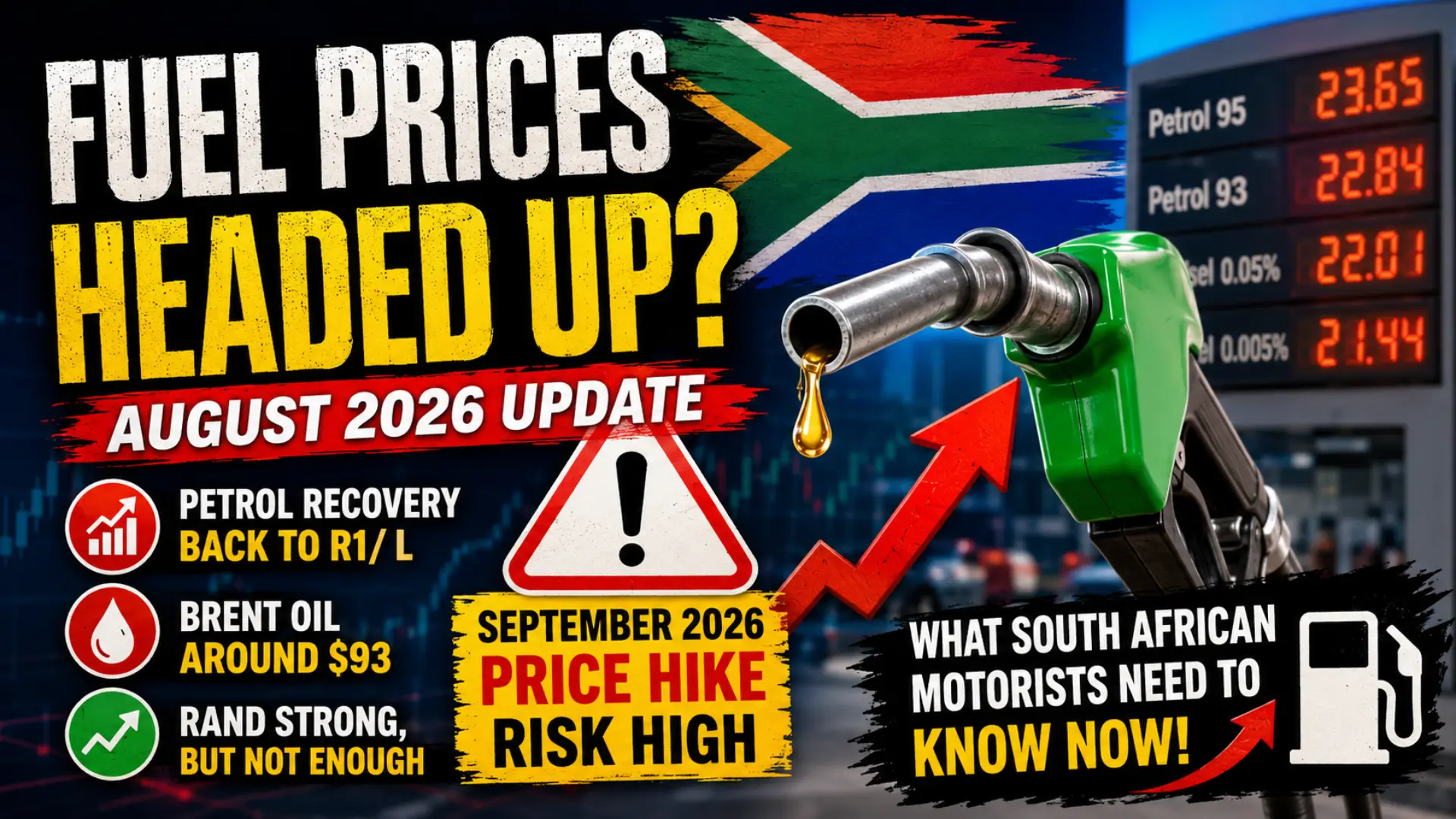
South Africa’s fuel price outlook has taken another negative turn in August 2026. Petrol price recoveries, which had improved around the middle of the month, have now moved close to the levels seen at the beginning of August. The latest Central Energy Fund (CEF) data shows that Petrol 95 is sitting at an under-recovery of about R0.99 per litre, while Petrol 93 is at around R0.88 per litre.
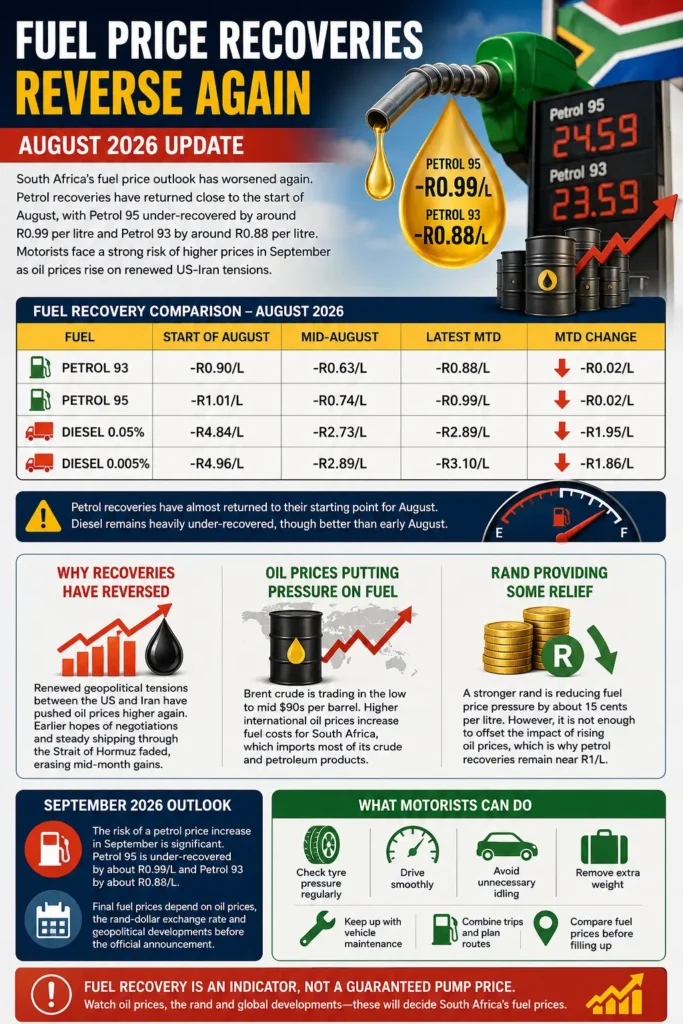
This means motorists are once again facing a serious risk of higher petrol prices in September. The situation is being driven mainly by higher international oil prices linked to renewed US-Iran tensions, while the stronger rand is providing some relief but not enough to cancel out the pressure from crude oil.
What Does Fuel Price Recovery Mean in South Africa?
Fuel price recovery is an important indicator used to estimate whether South African motorists could face a fuel-price increase or decrease at the next monthly adjustment. The Central Energy Fund tracks factors such as international petroleum prices and the rand-dollar exchange rate during the review period.
You can also read: TUT 2027 Applications: Check Study Opportunities
An under-recovery generally indicates upward pressure on the local pump price, while an over-recovery points towards potential price relief. However, CEF daily or weekly recovery figures are not the final official fuel-price adjustment. The final decision can also include other government-administered adjustments and is announced by the relevant authorities.
Latest Fuel Recovery Data for August 2026
The latest figures show a major reversal in the petrol recovery trend. Earlier in August, the under-recovery improved significantly, creating hope that September fuel prices might remain stable. That improvement has largely disappeared as oil prices climbed again.
The table below shows how the recovery position has changed during August:
| Fuel | Start of August | Mid-August | Latest MTD | MTD Change |
|---|---|---|---|---|
| Petrol 93 | -R0.90/L | -R0.63/L | -R0.88/L | -R0.02/L |
| Petrol 95 | -R1.01/L | -R0.74/L | -R0.99/L | -R0.02/L |
| Diesel 0.05% | -R4.84/L | -R2.73/L | -R2.89/L | -R1.95/L |
| Diesel 0.005% | -R4.96/L | -R2.89/L | -R3.10/L | -R1.86/L |
The figures show that petrol has almost returned to its starting position for August. Diesel is also under-recovering heavily, although its position remains considerably better than it was at the beginning of the month.
Why Have Petrol Recoveries Reversed?
The main reason is the renewed pressure on international crude oil prices. Earlier in the month, oil prices eased as markets hoped that the US-Iran conflict could move towards negotiations and that some shipping through the Strait of Hormuz would continue.
That optimism helped bring petrol’s under-recovery down from roughly R1 per litre to around 50–70 cents per litre. However, those gains have since been largely erased as geopolitical tensions increased again and markets began pricing in a greater risk of disruption to global oil supplies.
Oil Prices Are Putting Pressure on South African Fuel
Brent crude has recently traded around the low-to-mid $90s per barrel. Reuters reported on August 24 that Brent had recently reached about $93.38 per barrel after gaining roughly 5% over the previous week, with investors watching developments around possible new US sanctions against Iran.
For South Africa, higher crude prices matter because the country imports most of the crude and petroleum products needed for its fuel market. When international prices rise, the domestic fuel-price formula comes under pressure, particularly when the rand does not strengthen enough to compensate.
The Rand Is Providing Some Relief
There is one important positive factor in the latest fuel-price outlook: the South African rand has remained relatively resilient against the US dollar.
A stronger rand makes internationally priced oil cheaper in rand terms. According to the latest recovery analysis, the rand is reducing the fuel-price pressure by roughly 15 cents per litre, helping to offset part of the increase caused by crude oil.
However, the currency’s benefit is currently not large enough to overcome the impact of higher oil prices. This is why petrol recoveries have moved back towards a roughly R1-per-litre under-recovery despite the rand’s comparatively strong performance.
Diesel Recovery Is Better Than Petrol, But Still Negative
Diesel has not experienced exactly the same U-turn as petrol. Although diesel remains deeply under-recovered, its current position is still considerably better than at the beginning of August.
At the start of the month, diesel under-recoveries were close to R5 per litre. The latest figures place them at approximately R2.89 per litre for 0.05% diesel and R3.10 per litre for 0.005% diesel.
This is still a major warning sign because diesel is widely used by commercial transport, agriculture and businesses. A large diesel increase can therefore have wider economic consequences by raising transportation and logistics costs.
US-Iran Tensions Could Make the Fuel Outlook Worse
The geopolitical situation remains one of the biggest risks for South African fuel prices. The United States is preparing additional economic measures against Iran, while China has criticised unilateral sanctions and warned that further pressure could increase tensions.
You can also read: SRD Payment Dates for September 2026
The Strait of Hormuz is particularly important because disruptions in this major oil-shipping route can affect the movement of crude and petroleum products. Even when the physical supply shortage is limited, the fear of future disruptions can cause oil traders to push prices higher.
What New Iran Sanctions Could Mean
If sanctions further restrict Iranian oil exports or create additional problems for shipping through the region, international oil prices could remain elevated. China is also an important factor because it has historically been a major buyer of Iranian crude, making Chinese-Iranian oil trade a potential focus of future US measures.
For South African motorists, the key point is that another sharp rise in Brent crude could quickly worsen the CEF under-recovery before the August review period ends.
Is a September 2026 Petrol Price Increase Coming?
Based on the latest CEF recovery figures, the risk of a September petrol price increase is now significant. Petrol 95 is showing an under-recovery close to R1 per litre, while Petrol 93 is also close to the same level.
Earlier August data had provided some hope that the recovery could return to neutral by month-end. That scenario has become less likely after the latest reversal in oil prices.
However, motorists should not treat the current under-recovery as the final September increase. The figures can change every day as the rand and international petroleum prices move.
What Could Still Change Before the Final Fuel Price Announcement?
There is still time for the recovery position to move in either direction before the official September adjustment is announced. A sustained decline in crude prices would reduce the under-recovery, while a stronger rand could provide additional relief.
On the other hand, further escalation in the Middle East, disruption to oil shipments or another major jump in Brent crude could push the expected increase higher.
Motorists should therefore watch these indicators during the final part of August:
- Brent crude oil: A sustained move higher would increase fuel-price pressure.
- Rand/dollar exchange rate: A stronger rand can reduce the impact of expensive oil.
- Strait of Hormuz shipping: Further disruption could trigger another oil-price spike.
- US-Iran developments: Sanctions, negotiations or military escalation could quickly affect global markets.
- Final CEF recovery figures: These provide a better indication as the review period approaches its conclusion.
What Should South African Motorists Do Now?
Motorists should avoid treating early recovery figures as guaranteed pump-price changes. The CEF data is useful for understanding the direction of the market, but the final official adjustment is only known after the complete review and government announcement.
If your household or business has a tight fuel budget, it is sensible to prepare for a possible September increase rather than assuming that the earlier improvement will return.
Practical Fuel-Saving Tips
A few simple driving habits can reduce the impact of higher petrol prices:
- Maintain correct tyre pressure.
- Avoid unnecessary idling.
- Accelerate and brake smoothly.
- Remove unnecessary weight from the vehicle.
- Combine multiple short trips where possible.
- Compare nearby fuel stations before filling up.
- Keep up with regular vehicle maintenance.
These steps will not change the official petrol price, but they can reduce how much fuel your vehicle consumes each month.
Common Mistakes When Reading CEF Fuel Recoveries
One of the biggest mistakes is assuming that an under-recovery of R0.99 automatically means petrol will increase by exactly 99 cents per litre. The CEF recovery is an indicator, not a guaranteed final pump-price adjustment.
You can also read: Request Identity Verification for SASSA
Another mistake is looking only at crude oil prices. The rand-dollar exchange rate is equally important because international oil is priced in US dollars. A strong rand can soften the effect of higher oil prices, while a weaker rand can make the same barrel of crude more expensive for South African importers.
Fuel Recovery South Africa August 2026
The August recovery data has changed from a potentially manageable situation into a much more concerning September fuel-price outlook. Petrol 95’s under-recovery has moved back to approximately R0.99 per litre, almost exactly where it started the month, while diesel remains under significant upward pressure.
The stronger rand remains a valuable buffer, but international oil prices and Middle East developments are currently the dominant risks. With Brent crude still around the $90-plus level and the possibility of additional US sanctions against Iran, South African motorists should be prepared for the possibility of higher fuel costs in September.
Conclusion
The latest Fuel Recovery South Africa August 2026 data sends a clear warning: the temporary improvement seen earlier in the month has largely disappeared. Petrol prices are once again showing close to a R1-per-litre under-recovery, while diesel remains around R3 per litre below the level needed to cover current costs.
The final September fuel-price adjustment is not yet guaranteed, and the recovery can still change before the official announcement. For now, however, the trend suggests that motorists should prepare for another difficult month at the pumps unless oil prices fall significantly or the rand strengthens enough to offset the international oil shock.

