Bad News for People Traveling to South Africa Jet Fuel Price Increase

The sharp rise in jet fuel prices has become a serious concern for airlines and passengers traveling to and from South Africa. Over a short period, aviation fuel costs have surged dramatically, putting pressure on airline operations and ultimately increasing ticket prices. This situation is not limited to one region it reflects a global challenge linked to geopolitical instability and supply disruptions.
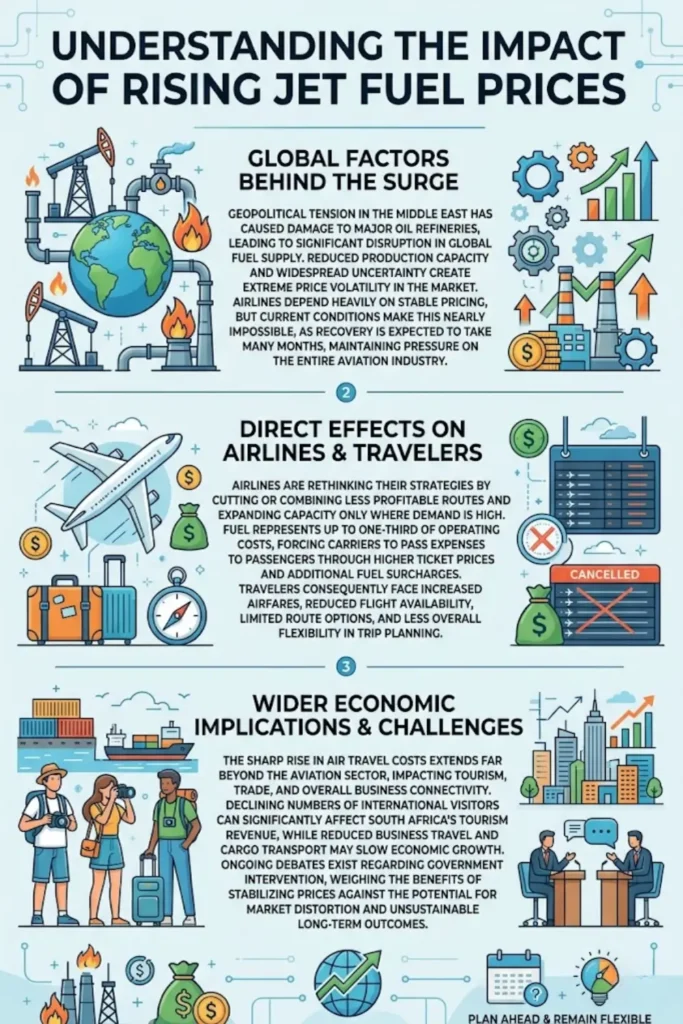
For travelers, this means higher fares, fewer flight options, and less flexibility when planning trips. Airlines are being forced to rethink their strategies, balancing rising costs with maintaining customer demand. Understanding what’s happening behind the scenes can help passengers make smarter travel decisions.
What Caused the Sudden Increase in Jet Fuel Prices
The primary reason behind the spike in jet fuel prices is geopolitical tension in the Middle East. Damage to key oil refineries has disrupted production, leading to uncertainty in global fuel supply. Even when shortages are not immediate, uncertainty alone can push prices higher.
Airlines depend heavily on stable fuel pricing, but current conditions have made that nearly impossible. The time needed to restore damaged refineries is expected to be several months, meaning the pressure is unlikely to ease soon.
Key factors driving the increase include:
- Damage to major oil refineries
- Reduced fuel production capacity
- Global supply chain uncertainty
- Market speculation and price volatility
You can also read: SASSA Grants Payment Dates
How Airlines Are Responding to Rising Costs
Airlines are not standing still in the face of rising expenses. Instead, they are actively adjusting their operations to reduce financial strain. One of the most noticeable changes is the reduction of flights on less profitable routes while increasing capacity on routes that generate higher revenue.
These adjustments are carefully calculated to maintain efficiency without losing too many customers. However, passengers may experience fewer travel options and longer waiting times between flights.
Common airline strategies include:
- Cutting or combining low-demand flights
- Increasing ticket prices or adding fuel surcharges
- Expanding high-demand and profitable routes
- Improving fuel efficiency where possible
Why Ticket Prices Are Increasing
Fuel is one of the largest expenses for airlines, often accounting for up to one-third of their operating costs. When fuel prices rise sharply, airlines have little choice but to pass some of that cost onto passengers.
Another challenge is that tickets are often sold months in advance. Airlines set prices before knowing what fuel will cost at the time of the flight, making it difficult to manage risk.
Reasons ticket prices are rising:
- Fuel costs have more than doubled recently
- Airlines must recover operational expenses
- Long-term ticket sales limit pricing flexibility
- Uncertainty forces cautious pricing strategies
Impact on Travelers and Demand
As ticket prices increase, many travelers are reconsidering their plans. Even small increases in airfare can significantly affect demand, especially for leisure travel. This decline in demand may lead to fewer flights, creating a cycle of reduced availability and higher prices.
However, a drop in demand could also ease pressure on fuel consumption, giving airlines some temporary relief.
Effects on travelers include:
- Higher ticket prices
- Reduced flight availability
- Limited route options
- Increased planning complexity
Broader Economic Effects of Rising Air Travel Costs
The impact of expensive air travel extends far beyond airlines and passengers. Air connectivity plays a crucial role in tourism, trade, and business activities. When flights become expensive or less frequent, entire industries can feel the effect.
Tourism, in particular, may suffer as fewer international visitors choose South Africa as a destination. Business travel and cargo transport may also slow down, affecting economic growth.
Economic consequences may include:
- Decline in tourism revenue
- Reduced business travel opportunities
- Slower trade and cargo movement
- Negative impact on local businesses
Cost Comparison: Jet Fuel Price Surge
| Time Period | Average Price per Litre | Impact Level |
|---|---|---|
| Previous Month | R11.50 | Stable |
| Current Range | R25 – R28 | Extremely High |
| Expected Outlook | Uncertain | Volatile |
This sharp increase shows how quickly costs have escalated, making it difficult for airlines to maintain stable pricing.
Airline Cost Structure Breakdown
| Expense Category | Percentage of Total Costs |
|---|---|
| Fuel | 30% – 35% |
| Staff | 20% – 25% |
| Maintenance | 10% – 15% |
| Operations | 15% – 20% |
| Other Costs | Remaining % |
Fuel clearly represents a major portion of airline expenses, which explains why price increases have such a strong impact.
Should Governments Intervene?
There is ongoing debate about whether governments should step in to support airlines during this crisis. Some argue that subsidies could help stabilize ticket prices and maintain connectivity. Others believe this approach could create long-term economic distortions.
Critics of subsidies point out that air travel is often used more by higher-income individuals, meaning financial support might not benefit the broader population fairly.
Arguments against subsidies include:
- Market distortion risks
- Unsustainable long-term solution
- Benefits may favor wealthier travelers
- Government funds may be needed elsewhere
You can also read: NSFAS Under Administration
Conclusion
The rise in jet fuel prices is creating a challenging environment for both airlines and passengers traveling to South Africa. Higher ticket prices, reduced flight options, and ongoing uncertainty are likely to continue in the near future.
Travelers should plan ahead, compare options carefully, and remain flexible with their schedules. While the situation may stabilize over time, the current outlook suggests that air travel will remain expensive and less predictable for the foreseeable future.
