Applications for 2027 University in South Africa Check Full Details

South Africa has officially opened applications for the 2027 university intake, marking the start of a highly competitive admission season. With a record number of matric graduates and increasing demand for higher education, students must act early to secure their place. This cycle is expected to be more challenging than previous years due to limited university capacity and rising application numbers.
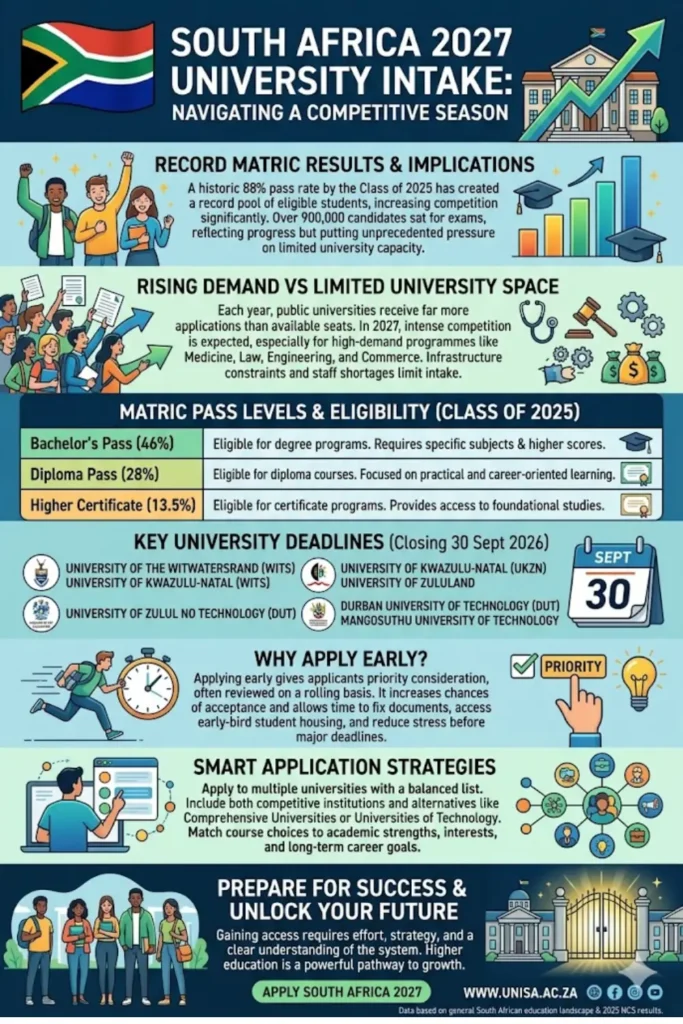
The strong performance of the Class of 2025, which achieved an impressive 88% National Senior Certificate pass rate, has significantly increased the pool of eligible applicants. While this reflects progress in the education system, it also means that universities will face greater pressure to accommodate students.
Record Matric Results and What They Mean
The Class of 2025 set a historic benchmark with the highest pass rate ever recorded in South Africa. Over 900,000 candidates participated in the exams, making it the largest matric cohort in the country’s history. This milestone shows improvement in basic education, but it also creates new challenges for higher education institutions.
Despite the success, deeper analysis reveals a more complex reality. Out of 1.25 million learners who started Grade 1 in 2014, only about 684,640 successfully passed matric in 2025. This highlights ongoing issues with learner retention and progression through the education system.
- A significant increase in overall pass rate
- Large number of students qualifying for higher education
- Ongoing concerns about dropout rates in earlier school years
- Growing pressure on universities to expand capacity
You can also read: SASSA Child Support Grant
Rising Demand vs Limited University Space
Each year, South Africa’s public universities receive far more applications than available seats. With over 656,000 students passing matric in 2025, competition for admission in 2027 is expected to be intense.
High-demand programmes such as Medicine, Law, Engineering, and Commerce continue to attract the majority of applicants. However, universities face several challenges that limit their ability to increase intake.
Some of the major constraints include:
- Limited infrastructure and classroom space
- Shortage of qualified academic staff
- Budget and funding restrictions
- High demand for student accommodation
These challenges mean that not all qualified students will gain admission, making early and strategic applications essential.
You can also read:
Bachelor, Diploma, and Certificate Pass Levels
Not all matric passes are equal when it comes to university admissions. The level of pass determines which type of programme a student can apply for. In 2025, the distribution of pass levels played a crucial role in shaping admission opportunities.
Here is a breakdown of pass levels:
| Pass Type | Percentage of Students | What It Means |
|---|---|---|
| Bachelor’s Pass | 46% | Eligible for university degree programs |
| Diploma Pass | 28% | Eligible for diploma courses |
| Higher Certificate | 13.5% | Eligible for certificate programs |
Students aiming for competitive degree programmes must meet requirements beyond the minimum bachelor’s pass, including specific subject marks and admission scores.
Universities Open for 2027 Applications
Several major universities have already opened their application portals for 2027. Students should note the deadlines and apply as soon as possible to avoid missing out.
Some universities and their closing dates include:
| University Name | Application Closing Date |
|---|---|
| University of the Witwatersrand | 30 September 2026 |
| University of KwaZulu-Natal | 30 September 2026 |
| University of Zululand | 30 September 2026 |
| Durban University of Technology | 30 September 2026 |
| Mangosuthu University of Technology | 30 September 2026 |
Important points to remember:
- Some courses close earlier, especially health sciences
- Application fees may apply
- Each university has different admission criteria
- Online applications are the most common method
Why Early Application Matters
Applying early significantly increases a student’s chances of securing a place, especially in competitive fields. Universities often review applications on a rolling basis, meaning early applicants may receive priority consideration.
Delaying applications can result in missed opportunities, especially for programmes with limited capacity. Early planning also allows students to correct mistakes or submit missing documents in time.
Benefits of applying early include:
- Better chances of acceptance
- More time to prepare required documents
- Access to student housing opportunities
- Reduced stress closer to deadlines
Smart Application Strategies for Students
Applying to university is not just about meeting minimum requirements. It requires careful planning and informed decision-making. Students should explore multiple options and avoid relying on a single application.
A balanced strategy can improve admission chances and reduce the risk of rejection.
Recommended strategies:
- Apply to multiple universities
- Choose a mix of competitive and less competitive institutions
- Consider universities of technology and comprehensive universities
- Match course choices with academic strengths
- Research career outcomes before selecting a programme
You can also read: South Africa Fuel Price Hikes
Choosing the Right Course and Career Path
Selecting the right course is one of the most important decisions a student will make. Research shows that the field of study and personal circumstances greatly influence graduation success and career outcomes.
Students should not simply follow trends or peer choices. Instead, they should focus on their strengths, interests, and long-term goals.
Factors to consider when choosing a course:
- Personal interest and passion
- Academic performance in relevant subjects
- Job market demand
- Financial considerations
- Availability of bursaries or scholarships
Challenges in the Education System
While the rising pass rate is encouraging, South Africa’s education system still faces several challenges. Issues such as dropout rates, inequality, and resource limitations continue to impact student success.
Universities are also under pressure to maintain quality while increasing access. Balancing these two goals remains a key concern for policymakers and education experts.
Major challenges include:
- High dropout rates before matric
- Limited access to higher education
- Inequality between schools and regions
- Financial barriers for students
Conclusion
The 2027 university application season presents both opportunities and challenges. While more students are qualifying for higher education, the competition for limited spaces continues to grow.
Success in this process requires preparation, awareness, and timely action. Students who plan ahead, apply early, and make informed decisions will have a stronger chance of securing admission.
You can also read: SASSA Office Hours Check
In the end, higher education remains one of the most effective pathways to personal and professional growth in South Africa. However, gaining access requires effort, strategy, and a clear understanding of the system.
