NSFAS February 2026 Payment Schedule Check Funding Update Over 1 Million Students Approved

The National Student Financial Aid Scheme (NSFAS) has officially confirmed that more than one million students will receive financial support for the 2026 academic year. This announcement brings massive relief to students and families who depend on financial aid to access higher education in South Africa.
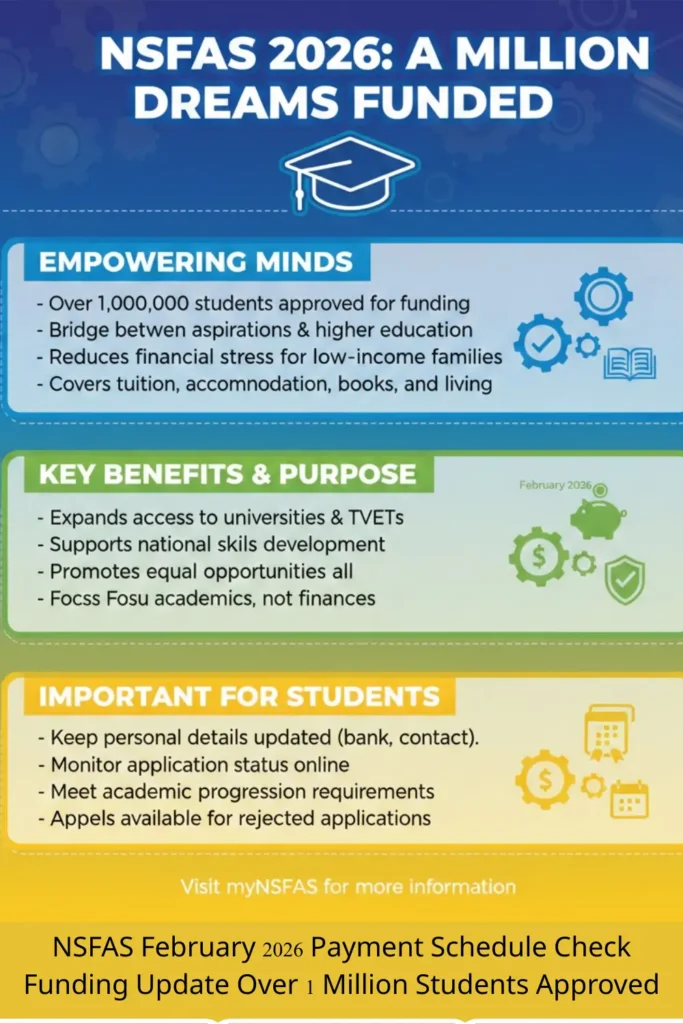
For many young people, NSFAS is not just a funding scheme it is the bridge between dreams and reality. With rising education costs and increasing living expenses, this funding ensures that students from low-income households can focus on their studies without the constant stress of money.
NSFAS Funding in South Africa
NSFAS plays a central role in South Africa’s education system. It ensures that financial limitations do not block talented students from pursuing tertiary education.
Higher education is expensive, and without assistance, many students would never step into a university or TVET college. NSFAS helps close this gap by covering essential study-related expenses for eligible students.
What NSFAS Stands For and Its Purpose
NSFAS is a government-funded bursary scheme created to support poor and working-class students.
Its main goals include:
- Expanding access to higher education
- Reducing dropout rates
- Supporting national skills development
- Promoting equal opportunities
Who Benefits From NSFAS
NSFAS mainly supports:
- Students from low-income households
- First-time entering students
- Continuing students who meet academic requirements
This ensures funding reaches those who truly need it.
You can also read: Apply for SRD R370 Grant Check Documents Required
NSFAS 2026 Funding Announcement Explained
The 2026 funding announcement is one of the biggest in NSFAS history. The scheme confirmed that over one million students have been approved.
This reflects both an increase in applications and the growing demand for financial assistance across the country.
Record-Breaking Number of Approvals
The large number of approvals means:
- More young people can study
- Greater access to public universities and TVET colleges
- Stronger support for transformation in education
What This Means for Students
Students who are approved can:
- Register without upfront payments
- Receive allowances on time (if details are correct)
- Focus on academics rather than finances
More Than One Million Students Approved for 2026
The approved students include both new applicants and continuing students.
This shows that NSFAS is not only bringing new students into the system but also supporting those who are already progressing in their studies.
First-Time Applicants vs Continuing Students
- First-time applicants received a large share of approvals
- Continuing students had to meet academic progression rules
Academic Progression Requirements
To keep funding, students must:
- Pass enough modules
- Remain within allowed study duration
- Stay registered at an approved institution
Failure to meet these rules may lead to loss of funding.
NSFAS February 2026 Payment Schedule Overview
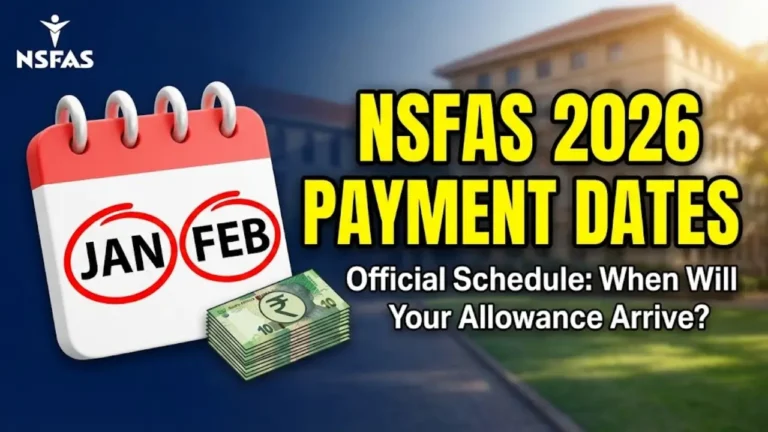
NSFAS usually releases allowances monthly, starting from February when the academic year begins.
Payments are processed after registration data is confirmed by institutions.
When Payments Are Expected
- First payments: 01, February 2026
- Monthly payments: March to November
- Catch-up payments: For late registrations
How Payments Are Released
- Direct bank transfers
- NSFAS payment channels
- Institution-linked disbursements
You can also read: How NSFAS Track Your Application Status Check Online Step by Step
Estimated February 2026 NSFAS Payment Timeline
| Payment Type | Expected Period |
|---|---|
| Registration & Tuition | Early February |
| Living Allowance | Mid-February |
| Book Allowance | Mid to Late February |
| Accommodation Allowance | February |
What NSFAS Funding Covers in 2026
NSFAS provides comprehensive support that covers most essential study costs.
This means students are not left scrambling for extra money.
Tuition and Registration
- Full tuition fees
- Registration fees
- Course-related academic charges
Accommodation and Living Allowances
- On-campus housing
- Accredited private accommodation
- Living allowance for daily needs
Full Breakdown of NSFAS Allowances
NSFAS allowances differ based on institution type and student needs.
Learning Materials Allowance
- Textbooks
- Study guides
- Digital resources
Transport Allowance
- For students living off-campus
- Covers commuting costs
Meal Allowance
- Supports daily food expenses
Common Allowance Categories
| Allowance Type | Purpose |
|---|---|
| Tuition | Course fees |
| Accommodation | Housing costs |
| Books | Learning materials |
| Transport | Travel costs |
| Living Allowance | Daily expenses |
Eligibility Criteria for NSFAS Funding
Not everyone automatically qualifies.
Students must meet specific requirements.
Household Income Threshold
- Combined household income below threshold
- Proof of income required
Citizenship and Institution Requirements
- South African citizen or permanent resident
- Registered at public university or TVET college
Why Updating Personal Information Is Critical
Incorrect details are one of the biggest causes of payment delays.
NSFAS processes thousands of payments, and even a small error can block your funds.
Common Errors Students Make
- Old phone numbers
- Wrong bank account details
- Misspelled names
Consequences of Outdated Details
- Delayed allowances
- Missed payments
- Registration problems
How to Update Your Details on myNSFAS
Updating your profile only takes a few minutes.
Step-by-Step Process
- Log into myNSFAS
- Open profile section
- Edit personal details
- Save changes
What Information to Review
- Contact details
- Banking details
- Residential address
You can also read: Details of Grants Awarded in SASSA 2026 Child Support
Step-by-Step Guide to Checking NSFAS Status
Checking your status keeps you informed and prepared.
Approved Status
Means funding is confirmed.
Provisionally Funded
- Conditional approval
- May require additional checks
Incomplete or Rejected
- Missing documents
- Eligibility issues
What to Do If Your NSFAS Application Is Declined
Rejection does not always mean the end.
Many students succeed through appeals.
Understanding the Reason
- Income threshold exceeded
- Missing documents
- Academic issues
Submitting an Appeal
- Upload supporting documents
- Explain changed circumstances
- Submit within deadline
NSFAS Appeal Process Explained
Appeals must be handled carefully.
Required Documents
- Updated income proof
- Academic records
- Supporting letters
Appeal Timelines
- Opened after results released
- Strict closing dates
Responsibilities of NSFAS-Funded Students
Funding comes with obligations.
Academic Performance
- Attend classes
- Pass modules
- Maintain progress
Compliance With Rules
- Honest information
- Proper use of funds
How NSFAS Funding Improves Access to Education
NSFAS has transformed lives across South Africa.
Reducing Dropout Rates: Students stay enrolled because they can afford to study.
Supporting Poor and Working-Class Families: Families are relieved from heavy financial burdens.
Common Myths About NSFAS Funding
Many misunderstandings exist.
Funding Is a Loan
NSFAS is mainly a bursary, not a traditional loan.
Only Top Students Qualify
Academic excellence helps, but financial need is key.
Tips to Avoid Payment Delays in 2026
Small actions can prevent big problems.
Early Preparation
- Update details early
- Register on time
Communication With Institutions
- Confirm registration
- Follow campus announcements
You can also read: NSFAS R5200 Delay 2026 If You are Having any Problems
Conclusion
The approval of over one million students for NSFAS funding in 2026 is a powerful step toward inclusive education. It shows the government’s commitment to empowering youth and building a skilled workforce. By keeping your information updated, monitoring your status, and meeting academic requirements, you can enjoy smooth funding throughout the year and focus fully on your studies.