NSFAS Disbursement Allowance 2026 & Check 2026 TVET Collage Allowance Breakdown

The National Student Financial Aid Scheme (NSFAS) continues to play a vital role in supporting more than a million South African students. For the 2026 academic year, NSFAS has introduced a more streamlined allowance structure designed to improve payment speed, transparency, and accountability.
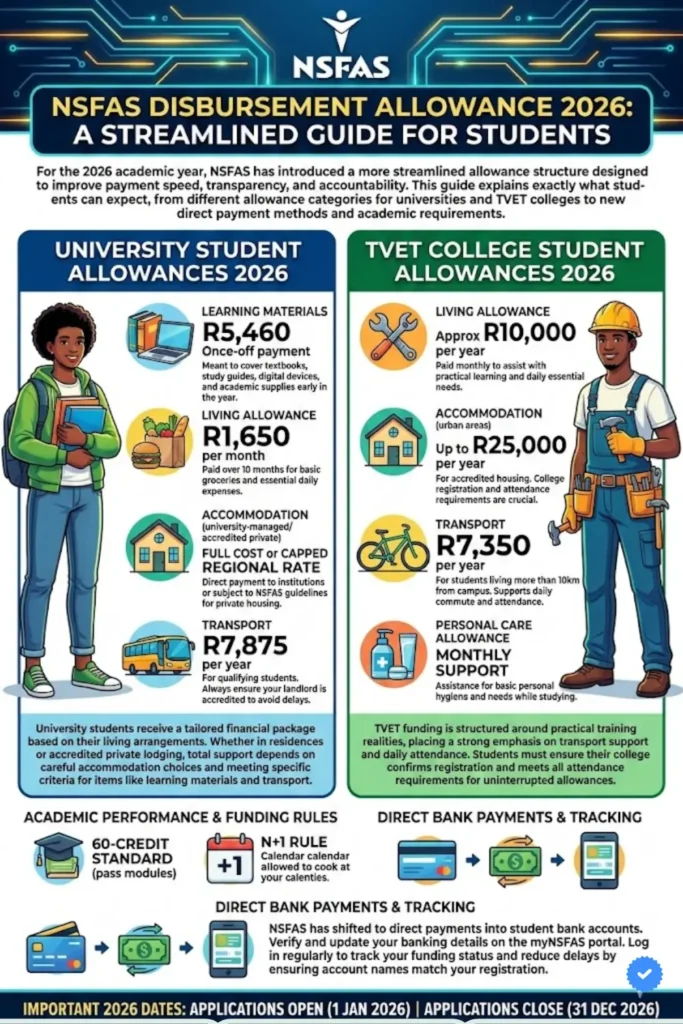
If you applied during the 2026 application window, which opened on 1 January 2026, this detailed guide explains exactly what you can expect to receive, how payments are made, and how to avoid common delays. Whether you are studying at a university or a TVET college, understanding your allowance structure is essential to managing your academic year successfully.
Overview of NSFAS Allowances for 2026
NSFAS funding is structured differently depending on whether you are registered at a university or a TVET college. The allowance categories are carefully designed to cover essential student needs such as accommodation, food, learning materials, and transport.
For 2026, the system focuses on:
- Faster direct payments into student bank accounts
- Clear allowance categories
- Academic performance monitoring
- Funding limited to the approved study duration (N+1 rule)
The goal is not only to provide financial relief but also to ensure students complete their qualifications within the funded timeframe.
You can also read: How to Download NSFAS App 2026
2026 University Allowance Breakdown
University students receive a tailored financial package based on their living arrangements. Your total support depends on whether you stay in university residences, accredited private accommodation, or at home.
The allowance categories include learning materials, living expenses, accommodation, and transport. Below is a clear summary of what university students can expect in 2026.
University Allowance Structure for 2026
| Allowance Category | Amount (2026) | Payment Structure |
|---|---|---|
| Learning Materials | R5,460 | Once-off payment at the start of the year |
| Living Allowance | R1,650 per month | Paid over 10 months |
| Accommodation (University Managed) | Full cost covered | Paid directly to institution |
| Accommodation (Private Accredited) | Capped at regional rate | Paid per NSFAS guidelines |
| Transport | R7,875 per year | For qualifying students |
Learning Material Allowance
Students receive approximately R5,460 as a once-off payment at the beginning of the academic year. This amount is meant to cover:
- Textbooks
- Study guides
- Digital devices
- Academic supplies
This payment is usually made early to ensure students are academically prepared from the first semester.
Living Allowance
The living allowance is R1,650 per month and is paid over 10 months. This funding is meant to assist with:
- Food
- Basic groceries
- Daily personal expenses
- Essential study-related needs
It is important to budget carefully because this allowance must last throughout the month.
Accommodation and Transport
Accommodation funding depends on where you stay:
- University-managed residences are fully covered.
- Private accommodation must be NSFAS-accredited and is subject to a capped regional rate.
- Students living at home or in non-accredited housing may qualify for transport funding of R7,875 per year.
Always confirm that your landlord is accredited to avoid payment delays.
2026 TVET College Allowance Breakdown
TVET students receive financial support structured around practical and transport-focused needs. Because many TVET students travel daily or require tools for hands-on training, the allowance structure reflects those realities.
You can also read: NSFAS Funding Crisis 2026 Aid
The TVET funding package for 2026 includes living support, accommodation (where applicable), transport, and personal care allowances.
TVET Allowance Categories
TVET students may receive:
- Living Allowance: Approximately R10,000 per year, paid monthly
- Accommodation (Urban Areas): Up to R25,000 per year for accredited housing
- Transport: R7,350 per year for students living more than 10km from campus
- Personal Care Allowance: Monthly support for hygiene and basic needs
Unlike university funding, TVET allowances place stronger emphasis on transport and daily attendance support.
Students must ensure:
- Their college registration is confirmed
- Attendance requirements are met
- Accommodation providers are accredited
Failure to meet these requirements may result in delayed or blocked payments.
NSFAS Direct Payment System for 2026
For 2026, NSFAS has largely shifted to a direct payment system. University students are now encouraged to receive funds directly into their personal bank accounts instead of the previous NSFAS Wallet system.
To avoid a “Pending” payment status:
- Log into your myNSFAS portal regularly
- Verify and update your banking details
- Ensure your bank account is in your own name
- Confirm your registration status is approved
Incorrect or unverified banking details are one of the biggest causes of delays in 2026 disbursements.
Academic Requirements: The 60-Credit Standard
NSFAS funding is not automatic year after year. Students must meet academic progression requirements to continue receiving allowances.
For 2026, students must pass between 50% and 60% of their modules, depending on their year of study. If too many subjects are failed:
- Funding may be suspended for the next semester
- Your status may change to “Blocked”
- Appeals may be required
This rule ensures that funding supports students who are making academic progress.
Understanding the N+1 Funding Rule
NSFAS funds students for the official duration of their qualification plus one additional year. This is known as the N+1 rule.
For example:
- A 3-year degree is funded for a maximum of 4 years
- A 4-year degree is funded for up to 5 years
Students who exceed this limit, especially final-year students already on their extra year, may face rejection of further allowances in 2026.
Careful academic planning is essential to avoid losing funding due to extended study periods.
Important NSFAS Dates for 2026
Keeping track of deadlines is critical for uninterrupted funding.
Key 2026 dates include:
- Applications Opened: 1 January 2026
- Applications Close: 31 December 2026
- First Disbursement: Usually late February or early March
Students should not wait for SMS notifications. Portal updates are more reliable and faster.
How to Check Your 2026 NSFAS Payment Status
Tracking your allowance status is simple if you follow the correct steps. Many students experience confusion because they rely solely on SMS updates.
To check your payment:
- Visit my.nsfas.org.za
- Log into your account
- Click on “Track Funding Progress”
- Open the “Allowance” tab
- Check whether your payment shows “Disbursed” or “Pending”
If your payment is pending for an extended period, verify your banking details and registration status immediately.
You can also read: Submit Your NSFAS Application
Conclusion
The NSFAS Disbursement Allowance 2026 structure reflects a stronger focus on efficiency, accountability, and student success. University and TVET students receive tailored financial support based on their specific needs and living situations.
To ensure smooth payments in 2026:
- Keep your academic performance above the required threshold
- Verify your bank account details
- Confirm accommodation accreditation
- Monitor your myNSFAS portal regularly
Understanding your allowance breakdown empowers you to plan your finances wisely and focus fully on your studies. Proper preparation and awareness can prevent delays and ensure that your funding supports you throughout the academic year.
