R1,500 NSFAS Allowance April 2026 Check Reasons For Late Payments
The R1,500 NSFAS allowance for April 2026 is an important financial support for thousands of students studying at public universities and TVET colleges in South Africa. This payment helps students manage essential academic and living costs at the beginning of the academic year when expenses are usually high.
In this article, you will understand who qualifies for the allowance, when to expect payment, common reasons for delays, and how to check your status. Everything is explained in simple, clear language so you can take the right steps without confusion.
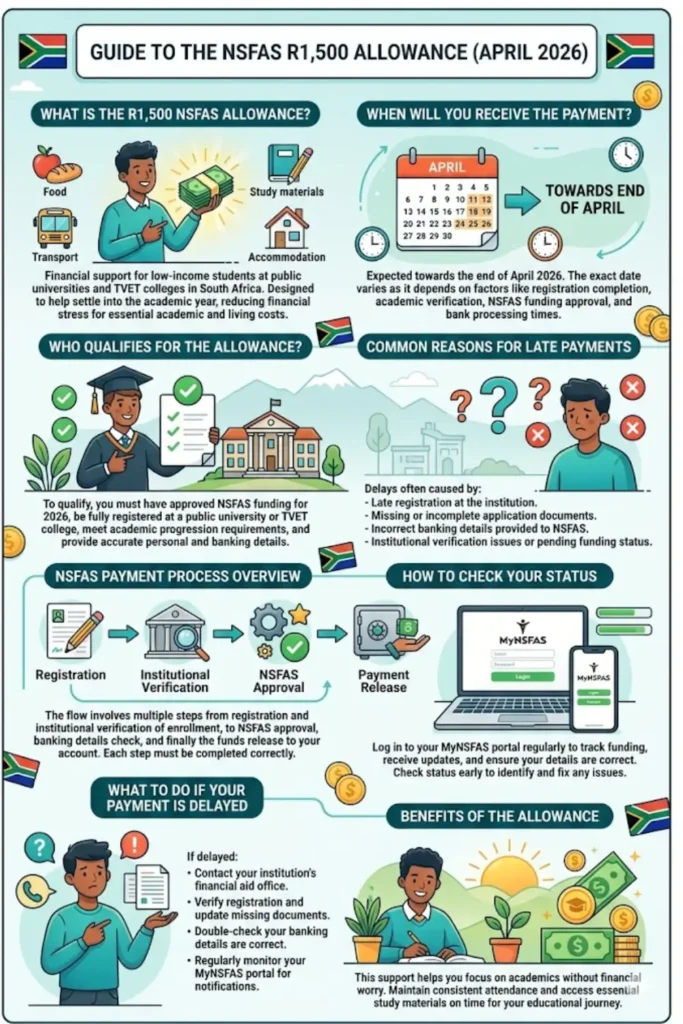
What Is the R1,500 NSFAS Allowance?
The NSFAS allowance is financial support given to students from low-income households. The April 2026 payment of R1,500 is designed to help students settle into the academic year smoothly without financial stress.
This allowance is especially important because it arrives at a time when students need to pay for multiple essentials. Many rely on this payment to cover daily living costs while focusing on their studies.
Students typically use this allowance for:
- Food and groceries
- Transport to and from campus
- Study materials like books and stationery
- Accommodation-related expenses
This support ensures that students can concentrate on their education rather than worrying about basic needs.
You can also read: Disbursement Allowance 2026
When Will Students Receive the April 2026 Payment?
Students can expect to receive their R1,500 allowance towards the end of April 2026. However, there is no single fixed payment date for all students.
The exact payment timing depends on several factors, mainly linked to institutional processes and verification systems. Each university or TVET college handles registration and payment processing differently, which can affect the timeline.
Important factors that influence payment timing:
- Completion of student registration for 2026
- Verification of academic enrollment
- Approval of NSFAS funding
- Bank processing times
Students who complete all requirements early are more likely to receive their payments on time, while others may experience slight delays.
Who Qualifies for the R1,500 NSFAS Allowance?
Not every student automatically receives this allowance. There are specific requirements that must be met to qualify for the April 2026 payment.
Students must be fully approved and actively enrolled in a recognized public institution. NSFAS also checks academic performance and compliance with funding rules.
To qualify, students must:
- Have approved NSFAS funding for 2026
- Be registered at a public university or TVET college
- Meet academic progression requirements
- Provide correct personal and banking details
If any of these conditions are not met, the payment may be delayed or not processed at all.
Common Reasons for Late NSFAS Payments
Although NSFAS aims to release payments on time, delays can still happen. These delays are usually caused by administrative or verification issues rather than system failures.
Understanding these reasons can help students fix problems quickly and avoid unnecessary waiting.
Here are the most common causes of delayed payments:
- Late registration at the institution
- Missing or incomplete documents
- Incorrect banking details
- Delays in institutional verification
- Pending approval of funding status
In many cases, payments are only processed once all issues are resolved. That is why it is important to ensure everything is accurate and up to date.
NSFAS Payment Process Overview
The process of receiving an NSFAS allowance involves multiple steps. Each step must be completed correctly to avoid delays.
Below is a simple breakdown of how the process works:
| Step | Description | Impact on Payment |
|---|---|---|
| Registration | Student registers at institution | Required to start process |
| Verification | Institution confirms enrollment | Enables funding approval |
| Approval | NSFAS confirms eligibility | Unlocks payment |
| Banking Check | Student banking details verified | Ensures successful transfer |
| Payment Release | Funds sent to student account | Final step |
If any step is incomplete, the payment will not be processed until the issue is fixed.
How to Check Your NSFAS Payment Status
Students are encouraged to regularly check their payment status to stay updated. This helps identify any problems early and avoid long delays.
The MyNSFAS portal is the main platform where students can track their funding and payment updates.
To check your status, follow these steps:
- Log in to your MyNSFAS account
- Check your funding status for 2026
- Review payment updates and notifications
- Confirm your banking details are correct
Keeping track of your status ensures you stay informed and can act quickly if there are any issues.
You can also read: How to Check myNSFAS Account
What To Do If Your Payment Is Delayed
If your April allowance does not arrive on time, there are steps you can take to resolve the issue. It is important not to panic but to investigate the cause.
Most delays are fixable once the problem is identified and corrected.
Here’s what you should do:
- Contact your institution’s financial aid office
- Verify your registration status
- Update incorrect or missing documents
- Double-check your banking details
- Monitor your MyNSFAS portal regularly
Taking these steps can speed up the process and help you receive your payment sooner.
How the R1,500 Allowance Supports Students
The April allowance plays a key role in helping students manage their academic journey. It provides financial stability during a crucial time in the academic calendar.
Without this support, many students would struggle to afford basic necessities, which could affect their studies.
This allowance helps students:
- Focus on academics without financial stress
- Maintain consistent attendance
- Access study materials on time
- Cover daily living expenses
By reducing financial pressure, NSFAS enables students to perform better and stay committed to their education.
Conclusion
The R1,500 NSFAS allowance for April 2026 is more than just a payment; it is essential support that helps students succeed academically. While most students will receive their funds by the end of April, delays can occur due to registration, verification, or banking issues.
You can also read: Universities Open for 2027 Applications
To avoid problems, students should ensure all their details are accurate, complete registration on time, and regularly check their MyNSFAS portal. Staying informed and proactive is the best way to ensure a smooth payment process.
