2027 University Applications South Africa Check New Important Details & Check Fee Deadlines

Planning for university admission in South Africa for 2027 can feel confusing, especially when every institution has different opening dates, closing deadlines, and application fees. If you want to avoid last-minute stress, missing documents, or late penalties, the best approach is to understand the process early and stay organised.
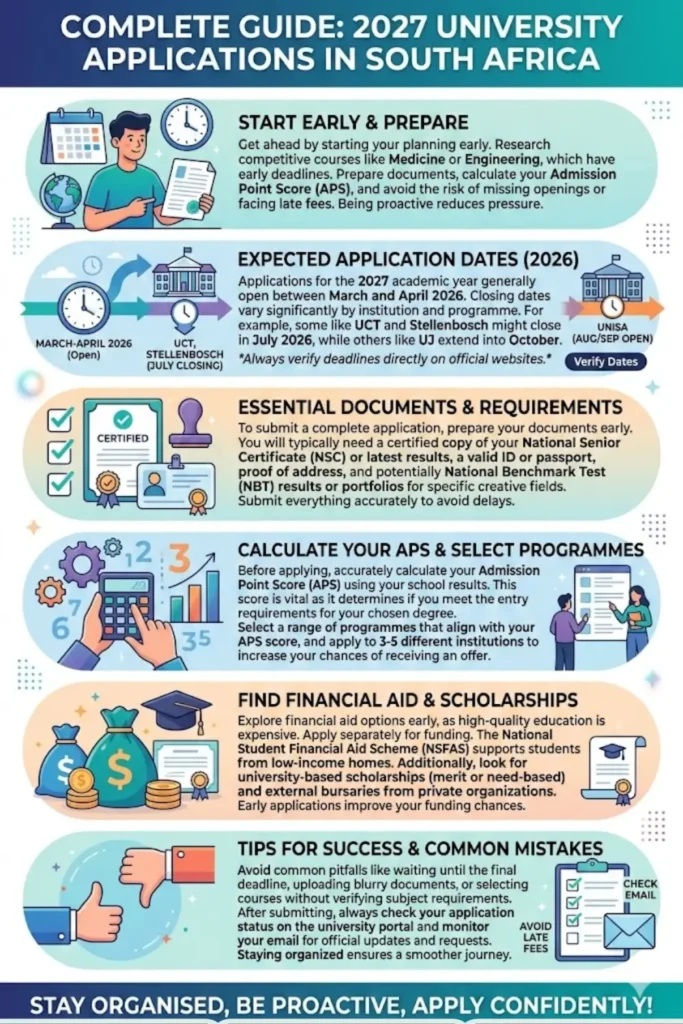
This complete guide explains 2027 university application dates, important fee deadlines, financial aid options, and practical tips to help you apply successfully. All information is presented in clear and simple language so you can confidently prepare for your academic journey.
Why Early Preparation for 2027 University Applications Matters
Applying to university is not just about filling out an online form. It involves checking admission requirements, calculating your APS score, preparing documents, and paying the correct application fee before the deadline.
Many competitive programmes such as Medicine, Dentistry, Veterinary Science, and Health Sciences close earlier than general courses. If you wait too long, you may lose the opportunity to apply, even if you meet the requirements.
Starting early allows you to:
- Track university opening and closing dates
- Prepare certified documents in advance
- Calculate your Admission Point Score (APS)
- Apply for financial aid on time
- Avoid late application penalties
Being proactive gives you more options and reduces unnecessary pressure.
You can also read: How to Download NSFAS App 2026
2027 University Applications Opening and Closing Dates
Most South African universities are expected to open applications between March and April 2026 for the 2027 academic year. However, closing dates vary depending on the institution and faculty.
Below is a simplified overview of major universities and their expected timelines:
| University | Expected Opening | Expected Closing | Application Fee |
|---|---|---|---|
| University of Cape Town (UCT) | April 2026 | 31 July 2026 | R100 (SADC) / R300 (International) |
| University of the Western Cape (UWC) | April 2026 | August–September 2026 | Free |
| Stellenbosch University (SU) | April 2026 | 31 July 2026 | R100 |
| University of Johannesburg (UJ) | April 2026 | October 2026 | Free (Online) |
| University of Pretoria (UP) | April 2026 | May–June 2026 | R300 |
| University of KwaZulu-Natal (UKZN) | March/April 2026 | June–September 2026 | R210–R490 |
| University of Limpopo (UL) | To Be Confirmed | To Be Confirmed | R200 (SA) |
| University of Fort Hare (UFH) | March 2026 | September 2026 | Check Website |
| University of South Africa (UNISA) | August/September 2026 | January 2027 | R135 |
These dates are subject to change. Always verify final deadlines directly on the official university website before submitting your application.
Understanding University Application Fees for 2027
Application fees are non-refundable payments required when submitting your application. The amount depends on your residency status and whether you apply online or manually.
In general:
- Many universities offer free online applications for South African citizens
- Manual or paper applications often cost between R100 and R500
- International applicants usually pay higher fees
- Late applications may include additional charges
Online applications are recommended because they are:
- Faster to process
- More affordable
- Easier to track
- Less likely to get lost or delayed
Make sure you keep proof of payment after submitting your fee.
You can also read: NSFAS Disbursement Allowance 2026
Key Requirements for a Successful 2027 Application
To complete your application smoothly, you must prepare the required documents in advance. Missing paperwork is one of the most common reasons applications get delayed.
Most universities require:
- Certified copy of your National Senior Certificate (NSC)
- South African ID or passport (for international students)
- Proof of residence
- Academic transcripts (if upgrading or transferring)
- Proof of application fee payment
Some competitive programmes may also require:
- National Benchmark Test (NBT) results
- Additional assessments or interviews
- Portfolio submissions (for creative courses)
Double-check faculty-specific requirements because they may differ from general admission rules.
Admission Point Score (APS) and Programme Selection
Before applying, it is important to calculate your APS score. This score determines whether you meet the minimum academic requirements for your chosen programme.
Universities calculate APS differently, but it is usually based on your best six or seven subjects from your NSC results.
To improve your chances of admission:
- Choose programmes that match your APS score
- Apply to at least three to five institutions
- Include both competitive and less competitive options
- Check subject-specific requirements
Applying strategically increases your chances of receiving at least one offer.
Financial Aid and Scholarships for 2027 Students
Higher education can be expensive, but financial support is available for qualifying students. It is important to apply for funding separately from your university application.
Main funding options include:
NSFAS Funding
The National Student Financial Aid Scheme (NSFAS) supports eligible students from low-income households. Applications usually open between September and November before the academic year begins.
NSFAS covers:
- Tuition fees
- Accommodation
- Learning materials
- Living allowances
You can also read: R5200 NSFAS Allowance Delays 2026
University-Based Scholarships
Many institutions provide merit-based or need-based scholarships. These are often awarded automatically based on academic performance, but some require separate applications.
External Bursaries
Private organisations, foundations, and companies also offer bursaries. These may require:
- Academic excellence
- Community involvement
- Field-specific commitments
Applying early improves your chances of receiving financial assistance.
Common Mistakes to Avoid During the Application Process
Many students lose opportunities because of avoidable errors. Being careful can make a significant difference.
Avoid the following mistakes:
- Waiting until the last week to apply
- Uploading unclear or uncertified documents
- Selecting programmes without checking requirements
- Ignoring early deadlines for competitive courses
- Forgetting to confirm application submission
After applying, regularly check your email and student portal for updates from the university.
What to Do If You Miss a Deadline
Missing a closing date does not always mean your academic journey is over, but your options may be limited.
If this happens:
- Contact the university admissions office immediately
- Ask about late application availability
- Consider institutions with later deadlines
- Explore bridging or foundation programmes
However, prevention is always better than correction. Keep a calendar reminder for each university you apply to.
You can also read: SASSA SRD R370 Payment Dates March
Conclusion
Applying for university in South Africa for 2027 requires planning, organisation, and careful attention to deadlines. Each institution has different requirements, fee structures, and closing dates. By starting early, preparing documents in advance, and applying strategically, you can significantly increase your chances of success.
Stay informed, verify all details on official university websites, and keep track of important dates. Your academic future depends on the steps you take today.